Diagrams, Documents, and the Meshing of Plans
1. Diagrams, Documents, and the Meshing of Plans1
Barry Smith
Preprint version of a paper to appear in András Benedek – Kristóf Nyíri (eds.)
VISUAL LEARNING, vol. 3: How To Do Things With Pictures: Skill, Practice, Performance
Abstract: There are two important ways in which, when dealing with documents, we go beyond the boundaries of linear text. First, by incorporating diagrams into documents, and second, by creating complexes of intermeshed documents which may be extended in space and evolve and grow through time. The thesis of this paper is that such aggregations of documents are today indispensable to practically all complex human achievements from law and finance to orchestral performance and organized warfare. Documents provide for what we can think of as a division of intellectual, instructional, and deontic labour, allowing plans, orders, and obligations to be enmeshed together in a way that often involves the use of diagrammatic elements, as for example in a musical score.
1.1. Preamble: From Linear Text to Images
Kristóf Nyíri has for some years defended a view of knowledge, communication and tradition which awards a central role to images of different sorts.2 Where speech and writing are in a certain sense linear (or we might better say unidimensional in time and in space, respectively), images are multi-dimensional, and in Nyíri's eyes this gives them great power. A sequence of images – for example the images displayed in the stained-glass windows of a medieval cathedral, or in a catalogue of structures of protein molecules – is a natural carrier of meaning that can allow messages to be conveyed of a graspable complexity which goes far beyond what could be achieved with speech, or linear transcriptions of speech, alone.
1 What follows is a transcript of a talk given at the conference on Visual Learning organized by Kristóf Nyíri in Budapest in December, 2013.
2 See for example his “Towards a Philosophy of the Mobile Information Society”, in: Herbert Hrachovec and Alois Pichler, eds., Philosophy of the Information Society, Frankfurt/M.: Ontos, 2008, pp. 149–163.
Such collections of images can also clearly serve an important pedagogical purpose, and as we shall see they can also assist in the planning of complex activities and in the communication of complex sets of instructions, as in Figure 1.3

A photograph showing five soldiers in camouflage uniforms gathered around a sand table in a wooded area. They are using sticks and small black markers to plan a mission. One soldier is pointing at the table while others observe or take notes.
Figure 1. Officer candidates preparing for a mission on a sand table
In our own day, of course, communication increasingly involves the use of devices that transmit multimedia messages enjoying a richness and dynamic character not found in the linear document forms which have prevailed hitherto. For Nyíri, indeed, as for Ferraris,4 the mobile phone is primarily not an instrument for communicating speech at all, but rather a device whose role lies much more in the communication of text, images and videos (soon, also, in effecting financial transactions). For Nyíri, indeed, the mobile phone represents “a new kind of collective thinking”.5
Nyíri has defended, too, a revisionary view of science which awards a central role to images and other forms of non-textual content in scientific communication. In this he finds support in the degree to which, as scientific papers are increasingly being published with on-line links to associated data, including video and audio content. Where, for Bolzano and Frege, as for many contemporary analytical philosophers, science is seen as a matter of propositions (of ‘sentences-in-themselves’ in Bolzano’s terminology), science on the Nyíri view comprehends not only the sorts of assertional content which can be formulated using sentences, but also diagrams, cartoons, photographs, and moving

4 Maurizio Ferraris, “Where Are You? Mobile Ontology”, in: K. Nyíri (ed.), Mobile Understanding: The Epistemology of Ubiquitous Communication, Vienna: Passagen, 2006, 41–53.
5 “Collective Thinking”, in: Kristóf Nyíri, ed., Mobile Understanding, op. cit., 91–100.
images. He has used these ideas, too, as the basis for new insights into the work of Wittgenstein, for example on the role of diagrams in rote learning.6
Through all these years I have disagreed strongly with Nyíri on all the above points. Now, however, I must confess that Nyíri was in important respects right in his insistence on the inadequacy of a view of human communication, including scientific communication, that is – like the Bolzanian view of science – modeled on linear text.
In many places, at least, Nyíri has been concerned with the importance of images and other supplements to linear text in describing reality. In what follows I want to focus rather on the deontic or performative ways in which both printed documents and written or spoken language are supplemented by non-linear artifacts in different sorts of human engagement with reality. I want to focus also on a departure from linearity in our use of written and printed language that is not addressed by Nyíri, which arises in virtue of the fact that the documents of central importance for collective activity are combined together to form document networks or complexes of different sorts.
1.2. How To Do Things With Documents
Familiarly, speech act theorists such as Reinach, Austin and Searle distinguished between different types of language use.7 First, we can use language to describe things. Second, we can issue instructions or commands or requests or entreaties designed to bring it about that certain things happen in the future. And third, we can baptize or promote or license people, thereby (roughly) bringing about immediate changes in their status.
But there are also ways of doing things with documents.8 Spoken descriptions may be written down and their content published. Agreements of the sort which in former times might have been sealed by handshake are concluded, today, through signatures on a piece of paper. The testimony of a witness before a court, similarly, is captured in a written record, which may in its turn become the object of further legal processes giving rise to further documents which become joined together in document complexes gradually expanding over time. To be skilled in legal process is to have the ability to navigate through a world that is shaped by such evolving complexes of documents.
In writings on speech act theory, the various ways we have of doing things with documents have hitherto been seen (more or less tacitly) as incidental accompaniments to speech. When we look more closely, however, then it becomes clear, that in the law and
6 As in “Wittgenstein’s Philosophy of Pictures”, in: Alois Pichler and Simo Säätelä, eds., Wittgenstein: The Philosopher and his Works, Wittgenstein Archives at the University of Bergen, 2005, 281–312.
7 On Reinach see Kevin Mulligan, “Promisings and Other Social Acts: Their Constituents and Structure”, in: Mulligan (ed.), Speech Act and Sachverhalt. Reinach and the Foundations of Realist Phenomenology. The Hague: Nijhoff, 1987, 29–90. See also J. L. Austin, How to Do Things with Words, Cambridge (MA): Harvard University Press, 1962 and John R. Searle, Speech Acts, An Essay in the Philosophy of Language, Cambridge: Cambridge University Press, 1969.
8 Barry Smith, “How to Do Things with Documents”, Rivista di Estetica 50, 179–198 and “Document Acts”, in Anita Konzelmann-Ziv and Hans Bernhard Schmid (eds.), Institutions, Emotions, and Group Agents. Contributions to Social Ontology (Philosophical Studies Series), Dordrecht: Springer, in press.
in many other areas of human activity, documents – and especially documents joined together in larger document complexes often containing non-textual elements of various kinds – engender new sorts of collaborations between large numbers of human beings and allow human actions to be extended in new sorts of ways across both time and space yielding consequences which would have been unattainable – indeed inconceivable – in a world in which we had to rely on speech and human memory alone.
1.2.1. Chemical Diagrams
Many documents incorporate diagrams or other graphic devices. Maps for instance are incorporated into title deeds and planning applications, and serve to anchor the latter to specific portions of land. Tax forms incorporate rows and columns to facilitate the recording, aggregation, and display of calculations. Your signature on the tax form certifies that you have seen and approved just those calculations which appear on the form. The signature itself then serves a graphic purpose, since it provides not only a record of a dated document act but also a graphic sample, which can be used for example for purposes of comparison where a question arises as to the author of this act.
It is a commonplace that diagrams – among which I am including arithmetical tables used in rote learning and mathematical equations used in scientific texts – are used in order to communicate knowledge in an easily learnable form. Such diagrams also allow progressively more complex ideas to be expressed and communicated in an easily surveyable form, thereby allowing the formulation and testing of every more ambitious scientific statements.
Diagrams are used also for industrial and scientific purposes for example as parts of protocols, as (in simplified form) in Error! Reference source not found.9

9 Image from Janna Hastings, Colin Batchelor, Fabian Neuhaus and Christoph Steinbeck, “What’s in an ‘is about’ link? Chemical diagrams and the Information Artifact Ontology”, Proceedings of the Second International Conference on Biomedical Ontology (ICBO 2011), CEUR, Volume 833, 2011.
And as attempts are made to follow the instructions contained in such protocols, multiple further documents will be generated relating to the materials ordered, the different settings used, the results achieved, and so forth.
1.2.2. Architectural Diagrams
And similarly in architecture, when someone submits an order along the lines illustrated (again in simplified form) in Error! Reference source not found.10

As this instruction is realized, further documents incorporating descendents of this blueprint will be engendered, some of them incorporating further diagrams with this master blueprint for example of the wiring or ventilation or plumbing for the building. Some of these documents will record commitments made in the successive stages of building, including permissions from local planning authorities, contracts with architects, builders and suppliers of materials, and so forth.
Typically, of course, matters concerning the role of these and other types of diagrams in the intermeshing of complex plans and subplans, and of the corresponding processes of realizing these plans, are more complicated. The initial blueprint will be accompanied by marginal annotations giving special instructions for example as to placement and quality of materials. To this will gradually be attached more and more supplementary documents, including contracts, planning applications, licenses, permissions, orders, receipts, amendments, approvals, and so forth. These documents themselves become modified and expanded as things go wrong in the building process, for example when it is found that needed materials are no longer available, or that rules governing tolerances for load-bearing walls have not been satisfied, or that fees have not been paid, or that contractors have reneged on their agreement. The blueprint here serves as just one component part of a progressively evolving document complex, which incorporates a representation both of the building which results from the execution of the plan and of the steps taken in this process of execution. These steps will then include a variety of different kinds of physical and document-related sub-processes – of approving plans, ordering and delivering materials, inspecting different aspects of the work done, providing insuring, and so forth
10 From http://www.dezeen.com/2012/09/27/slip-house-by-carl-turner-architects/. With acknowledgements to dezeen magazine.
– and they will be concluded (all being well) with a final document act in which you testify with your signature that the building is completed to your satisfaction.
Here again, we see that to realize a certain complex activity (here: the activity of building a building) those involved need an ability to navigate not merely through the world of actions and people and things but also through an evolving complex of interconnected documents relating to plans and subplans whose intermeshing will often be achieved through the incorporation of intermeshed diagrammatic elements.
Something similar holds across an even broader compass where the issue relates not to a single building but rather to the planning of entire neighborhoods and regions. Here the intermeshing will be achieved not least through the incorporation of cartographic elements, for example to map layers relating to geology, soil type, land use, water run-off, air quality, transport, and so forth.
1.3. Worlds Enhanced by Documents
To summarize what has been said thus far: the world in which we live is structured and embellished in different ways by an ever-growing variety of intermeshed document complexes. Both the processes and products of human activity are what they are to a surprisingly large degree because of the document complexes with which and through which they are intermeshed. We can bring about changes in the world not merely by performing physical acts by using a catalytic reactor or a duck bill trowel, but also by performing document acts – acts involving signing one’s name and depositing some form with a cognizant official, who will perform document acts of his own involving countersigning or stamping or storing. Examples of the sequelae of such acts include changes analogous to those brought about by speech acts of the third of our three types distinguished above, for example acts of baptizing or promoting, which bring about changes of status of their targets. Similar changes result, for instance, from the granting of a mortgage, or the award of a degree certificate or of a journeyman’s license, or of a release from prison. And all of these changes are initiated or marked or authorized through document acts of different sorts (often, of course, accompanied and sometimes made complete through speech acts – for example uses of the words “please” and “yes” when interacting with officials).
A long chain of writers, from Ong and Clanchy to Nyiri and Ferraris, have addressed the importance of literacy and of the associated technologies of communication in the development of modern civilization,11 including technologies for the creation and exploitation of systems of document complexes in the development of the modern systems of government so important to our existence as civilized beings. Teuscher, for example, describes how the emergence of formally organized archives in the later middle ages enabled what he calls a “mobilization” of regulations, meaning by this a process
11 Walter J. Ong, Orality and Literacy: The Technologizing of the Word, New York: Routledge, 2002; Michael T. Clanchy, From Memory to Written Record: England 1066-1307, 2nd ed., Oxford: Blackwell, 1993; Maurizio Ferraris, “Documentality, or Europe”, The Monist, 92 (2), 2009, 286–314, and Documentality: Why It Is Necessary to Leave Traces, New York: Fordham University Press, 2012.
whereby documents that had hitherto been seen as records of authoritative pronouncements in the past began increasingly to be seen as parts of document collections pointing to actions in the future.12 Such collections were enhanced for this purpose for example through the provision of tables of contents (capitulationes) and indices (abecedaria), and “recasting individual documents as part of larger textual contexts”, as Teuscher puts it, “ushered in an age of lawyers and of archives”.
Hernando de Soto has made analogous discoveries regarding the role of legal and commercial documents such as title deeds, mortgages, stocks, and insurance policies in ushering in the age of Western capitalism.13 As de Soto shows, because documents endure through time, they can serve as a record not merely of our behaviour in the past, but also of our obligations to others in the future. They also provide us with an evolving accounting of lessons learned from our successes and failures over time, for example as concerns our expertise or leadership skills or creditworthiness, in this way enhancing our human capital by making it recognizable to others (sometimes again through graphic means – as in the certificates which hang from the wall of a doctor’s office). They also allow human beings to commit themselves to ever more risky and ambitious collaborative endeavours, and even to endeavours which may relate to actions – for example the harvesting of slow-growth forests – which will be performed only when we are dead.
To achieve these ends, document complexes must be able to incorporate and thereby unify overlapping sets of documents addressing different audiences – as for example the planning documents kept by your local planning authority overlap (through the making of copies) with those kept by you, which overlap in turn with those kept by your solicitor. Documents may in this way acquire an organizing deontic power involving intermeshed sets of obligations entered into at different times by multiple different sets of persons and institutions. By creating document complexes out of sets of instructions with deontic force tailored to different sets of addressees in this way we can mobilize ever larger groups of people to create and maintain ever more complex orders through actions guided by corresponding sets of intermeshed plans and subplans. An orchestral score, for example, is a document complex consisting of a conductor’s score together with multiple part-scores addressing the separate groups of players.
1.4. From Speech Acts to Document Acts
Error! Reference source not found. is an instructional document expressed by means of a diagrammatic representation of a certain cartographic sort:14
12 Simon Teuscher, “Document collections, mobilized regulations, and the making of customary law at the end of the Middle Ages”, Archival Science, 10, 2010, 211–229.
13 Hernando de Soto, The Mystery of Capital: Why Capitalism Triumphs in the West and Fails Everywhere Else. New York: Basic Books, 2000. See also my “Searle and De Soto: The New Ontology of the Social World.” In The Mystery of Capital and the Construction of Social Reality, edited by B. Smith, D. Mark and I. Ehrlich. Chicago: Open Court, 2008, 35–51.
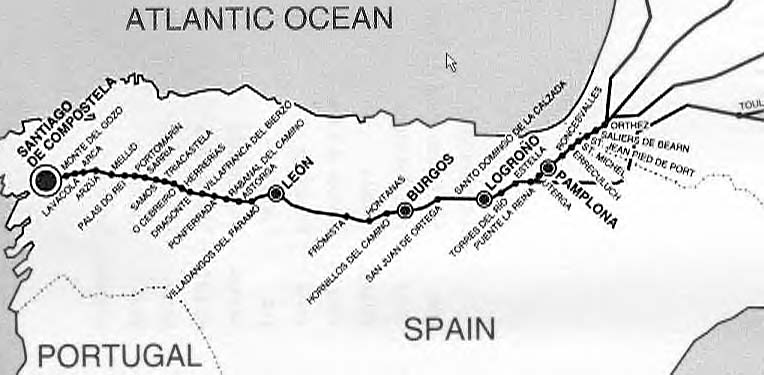

This map and its many predecessor maps were conceived by their creators and users not merely in cartographic but also in deontic terms. They are not merely guidelines for navigation but also – for the pilgrims for whom they were created – instructions with a certain obligatory force (which meant that they could be communicated more effectively to others, for example to the printers of pilgrim’s certificates and passports, planners and builders of hospitals and hospices along the route). On the assumption that their constituent instructions have been followed correctly, they can of course also be used as part of the pilgrim’s record of the pilgrimage, as an architectural blueprint, similarly, can serve both as a set of instructions and as part of a record of what was achieved when these instructions were followed.
1.4.1. Chains of Command
Documents serve to organize not only our physical and document-related actions, and to coordinate our collaborations with others, they also serve to mesh the obligations which we and they acquire which are needed to realize these actions in the appropriate way and in the appropriate order. Such chains of obligations can be highly complex, as in the case of organized warfare, where the entirety of an army’s plans for engagement can be seen as forming a document complex divided into plans and sub-plans to be realized by the responsible units and sub-units. We can see the documents in this complex as arranged, first, vertically, in a hierarchy corresponding to that of the command echelons, and, second, horizontally in a way that corresponds to the spatiotemporal arrangement of the planned interactions between different Blue Force units in the field.

The massive coordination of effort that made possible the D-Day landings presupposed the coordinated authoring of a massive collection of documents over a multi-year period, documents enmeshed with each other and with the associated plans and actions both vertically – between the different echelons of the military and civilian hierarchy involved – and also horizontally within each echelon. Early examples of organized warfare in the Shang Dynasty and under Genghis Khan rested similarly on the employment of written documents and maps, and drawing on a rudimentary postal service for the coordination of military operations.
1.5. The Ontology of Orchestral Performance
Consider what happens when a music impresario contracts (1) with an orchestra and concert hall manager to perform a certain program on a certain day, (2) with an advertising agency to publicize the concert, and (3) with a ticket agency to sell tickets for the concert. As tickets are sold, the impresario – and through him the conductor and members of the orchestra and the concert hall owner and manager – thereby become obligated to the purchasers of these tickets to realize the performance as described. The orchestra players, too, are in such a case obligated to the orchestra manager and to the conductor to rehearse and perform in the appropriate way and at the appropriate times. Dynamics and tempo during the performance are distributed across the different parts of the orchestra as determined by the conductor. The various members of the orchestra follow his instructions as to timing, emphasis, and so forth in performing the successive actions dictated by the score. The score is itself a complex of sets of diagrammatic instructions containing parts created for each of the different groups of instruments within the orchestra (perhaps supplemented by further diagrammatic sets of intermeshed instructions concerning lighting, microphone and camera placement, and so forth). These instructions are intermeshed, so that when the conductor raises his baton there is initiated on the part of the members of the orchestra a highly complex set of intermeshed obligations to perform in certain ways.
Orchestral performance is thus another clear example of how humans do things with (complex sets of intermeshed) documents which they could not do without their aid. Works of symphonic music themselves could not exist in the absence of scores,15 for the same sorts of reasons that it would be impossible to mount a large-scale military campaign without complex intermeshed sets of written orders transmitted to the front. Certainly there are musicians who are capable of performing even complex works from memory. But such performances presuppose organized rehearsal – as contrasted with what we might think of as the informal playing of music, where the score lacks deontic force and serves merely as a set of guidelines for the players – and the organized rehearsal of an orchestra in the performance of a work, including the correction of errors under the direction of the conductor – would be impossible in the absence of a score.
We can indeed assert quite generally that all forms of drill in complex organizations presuppose documentation of what counts as a correct performance. Such drill is indeed in large part designed to lead to the acquisition of expertise in interpreting and using instructional documents in appropriate ways.16
1.5.1. Massively Planned Social Agency
As Scott Shapiro points out in his “Massively Shared Social Agency”17 when philosophers, such as Searle, Gilbert or Bratman talk about collective action,18 they focus on small, local, interpersonal exchange between cooperating agents – agents who are aware of and largely agree about each other’s beliefs and desires – and on actions such as meeting for dinner or going for a walk or lifting a table or ordering un demi, Munich, pression, s’il vous plait in a Paris bar.
As Shapiro also notes, there is a major problem with this approach when applied to many types of human collaboration, since
it is highly unlikely that large-scale ventures such as industrial production or fighting a war under conscription can be staffed with individuals who are all committed to the same goals . . . . Alienation and massively shared agency usually go hand in hand.
15 For complementary arguments in support of this thesis see Lydia Goehr, The Imaginary Museum of Musical Works, Oxford: Oxford University Press, 1994.
17 Scott A. Shapiro, “Massively Shared Agency,” in M. Vargas and G. Yaffe, eds., Rational and Social Agency: Essays on the Philosophy of Michael Bratman, New York: Oxford University Press, forthcoming.
18 See Searle, The Construction of Social Reality. New York: Free Press, 1995 and Making the Social World: The Structure of Human Civilization. New York: Oxford University Press, 2010; Margaret Gilbert, On Social Facts. London: Routledge, 1989; Michael Bratman, Faces of Intention, Cambridge: Cambridge University Press, 1998.
In addressing this problem Shapiro takes as his starting point Bratman's treatment of the coordination of action in terms of the coordination of intentions and of the meshing of plans and sub-plans. Shapiro argues that an account of such coordination that can deal with large-scale social activity must award a central role to authority:
Without some centralized control over behaviour, the odds that many people will organize themselves towards the same objective and resolve their conflicts in a peaceful and efficient manner is apt to be low.
Large-scale ventures are possible in pluralistic societies, Shapiro argues, in virtue of the role played by legal authorities. The law provides a framework of trust which allows, for example, the sorts of major commitments in the form of risk capital to be made by actors which many large-scale ventures require. But how does it do this? To answer this question Shapiro points to the fact that the officials who exercise legal authority themselves form modules at different levels of authority, each module consisting of a small group of cooperating actors all of whom (we can here assume for the sake of argument) are highly committed to the following of the laws which regulate their own behaviour. Here, therefore, we are still dealing with the sorts of small-scale collaboration among like-minded individual actors to which Bratman's account applies.
Bratman falls short in failing to give an account of how the authority of the law becomes operative among civilians who have made no such commitment. Shapiro's intriguing solution to this problem rests on the modularizing power of the hierarchical division of authority, but shows how such hierarchical division creates a secondary effect in relation to those ordinary civilians who fall outside the hierarchy but are still subject to its authority:
Imagine that the fundamental rules of a legal system are shared plans and these plans not only accord legal power to legal officials over other legal officials, but over non-officials as well. When officials accept these plans, therefore, they will accept certain authority relations that hold both between themselves and between officials and non-officials. Thus, when some legal official issues a directive that applies to an ordinary citizen, other officials regard that directive as valid. In this way, legal authority over non-participants may be created.
Here, the intentions of civilian participants are irrelevant to the generation of the salient legal authority; what matters are the intentions of other legal authorities. The civilian has a subordinate legal status – is subject to the law – not because he has explicitly accepted this subordination, but because the participants in the legal system accept, are committed to, their shared plans to treat him as a subject.
As Shapiro himself points out, this analysis of the role of shared plans in the application of legal authority opens up an exciting possibility: "It would mean that the philosophy of law (and of social institutions more generally) could be understood as a branch of the philosophy of action."
If, however, we assume with Shapiro that legal authorities truly are built out of small societies of like-minded actors with shared plans, then this can be so, in the extended orders of contemporary society, only if there is an organized division of labour among such authorities through the same sorts of hierarchical chain of command structures and division of geographic and disciplinary jurisdictions of the sorts as those we find in military organizations. But now once again we encounter the indispensable role of documents and of document complexes in the mobilization of the necessary hierarchical orders. The workings of legal authorities presuppose a massive structure of documents, not merely for the formulation and transmission of plans and subplans, but also for the recording of deviations from these plans and for the formulation of the rules governing the processes involved in the correction of such deviations.
Shapiro affirms that the task of institutional design “is to create a practice that is so thick with plans and mesh-creating mechanisms that alienated participants end up acting in the same way as non-alienated ones”. Our contribution here is merely to draw attention to the fact that documents – especially documents incorporating diagrams – play an indispensable role in such institutional design, by (for example): recording the intermeshing of obligations between the participants involved, identifying the authorities who will intercede if these obligations are violated, and ensuring that their actions are coordinated, creating the expectation of the existence of such intermeshed obligations, creating the trust that is needed for the realization of ever more elaborate plans, and justifying investment in the necessary training of those involved in the appropriate ways to use the documents sustaining these expectations.
1.5.2. A Virtual Choir
Eric Whitacre’s Virtual Choir 3 was created in 2012 with the goal of creating an on-line choral performance of a work entitled “Water Night”, with Whitacre himself serving not only as composer and conductor but also as lead editor of some 3748 youtube videos submitted by performers from 78 countries.19 To be included in this performance, candidates were required to testify to their acceptance of certain “Terms and Conditions” of participation,20 including clauses such as following:
You hereby give all requisite consents under the UK Copyright Designs and Patents Act of 1988 (or any re-enactments or amendments thereof) to enable the Producers to edit your Performance together with audio visual material made by third parties to create a new composite Recording as part of the Virtual Choir series.
And also that
you agree not to violate any local or international laws, nor transmit any inappropriate, libellous, obscene or non-Virtual Choir related material. In consideration of the Producers agreeing to edit and create the Recording,
incorporating your Recording at their sole expense which you acknowledge is a good and valuable consideration, you confirm that the Producers shall be entitled in perpetuity throughout the world and without payment or liability to you, to alter and exploit the Recording in any manner and in all media worldwide.
The Producers retain the right to change these Terms if necessary, and these will be posted on the Virtual Choir webpage on www.ericwhitacre.com as necessary. If you object to these changes you will need to contact Music Productions Ltd. Continued use of the site indicates your acknowledgement of such changes and agreement to be bound by the terms and conditions.
The participants are required to warrant also that their Recording
is protected by international copyright laws without limitation. These Terms and the relationship between you and the Producers are governed by British law. These Terms remain in full force and effect in perpetuity.
For this virtual performance to come into being, therefore, required not only multiple laws to be in effect, but also multiple further documents, including Articles of Incorporation for Musical Productions, Ltd., Eric Whitacre, Inc., and so forth. Such documents, as should by now be clear, provided the framework of trust that was needed in order to allow a performance – both act and product – of the given sort to be created.
1.6. Conclusion
I have focused in the above on the two-fold way in which human beings transcend the boundaries of linear text (1) by incorporating diagrams into documents, (2) by creating complexes of documents which may be extended in space and evolve and grow through time.
The thesis, in sum, is that such aggregations of documents are indispensable not only to the workings of the law and finance and urban planning and of musical performance and organized warfare, but to practically all complex human achievements. That is, that without the peculiar phenomenon which is the multi-dimensional intermeshing of documents, many complex structured activities by which human life today is marked, would not exist. Documents provide for what we can think of as a division of intellectual, instructional, and deontic labour, allowing plans, orders, and obligations to be enmeshed together in a way that mobilizes multiple groups of individuals to coordinated action, while at the same time allowing the investment in human and other sorts of capital that such coordinated actions require.
Collections of intermeshed documents allow collective actions that are of a much larger scale and able to embrace much larger and much more diverse groups of people than would be possible on the basis of mere speech, and while I have concentrated in the above on supplements to written and spoken language which involve documents of traditional sorts, primarily printed documents, I hope that it is clear that much of what has been said applies with even greater force – and with even greater potentiality for engendering radical changes in the ways we engage with reality – to e-documents. This, however, is a story for another day.