Software project
HEAD 893c788b00
master, origin/HEAD, origin/master
Moppe
moppe Git repository
686 commits
497 files

Traces an overlooked subset–partition duality—from logic and category theory through entropy and quantum indefiniteness to selectionist and generative mechanisms in biology.
Develops accounting theory algebraically: balance vectors as modules, transactions as a group, and whole accounting systems as automata with quotients, homomorphisms, and decision algorithms for audit and control.
Ellerman's vector-accounting monograph: double entry generalized to property vectors ("accounting without valuation"), grounding a property-theoretic account of appropriation, the firm, and goodwill.

Develops implication as a refinement-sensitive operation on set partitions, showing how relative negation yields local Boolean cores within the non-distributive algebra of partitions.

NIST report proposing the Open Assembly Model, a UML-based object-oriented representation for electro-mechanical assembly information exchange.

Uses mereotopology and SWRL rules to represent assembly joints as ontological relations, illustrated on a fixture assembly case study.
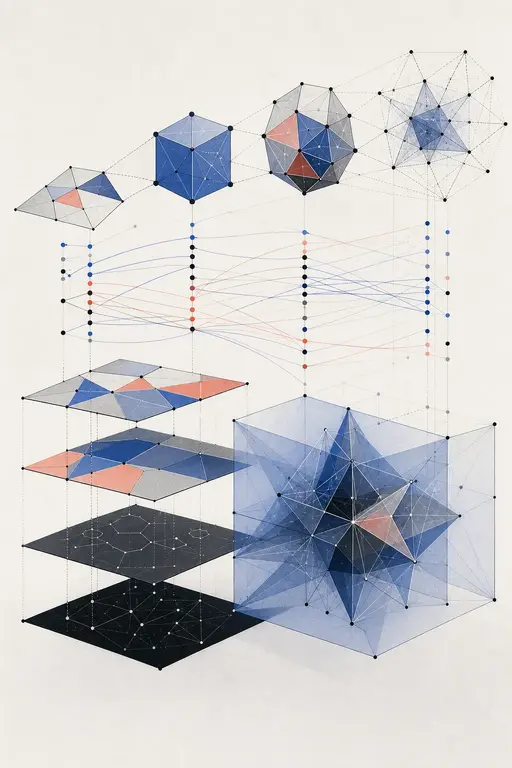
Formalizes geometric structures in d dimensions via combinatorial topology and order relations, a foundation for cell-complex representations used in assembly/geometric modeling.

Proposes a formal ontology of mechanical assembly structure intended to support generative design systems.

Introduces discrete exterior calculus, a coordinate-free discretization of differential forms on simplicial complexes for computational modeling.
Surveys finite element exterior calculus, unifying Hodge theory and mixed finite element stability analysis for PDE discretization.

Develops an operad-algebra formalism for open dynamical systems composed via wiring diagrams, underpinning compositional systems theory.
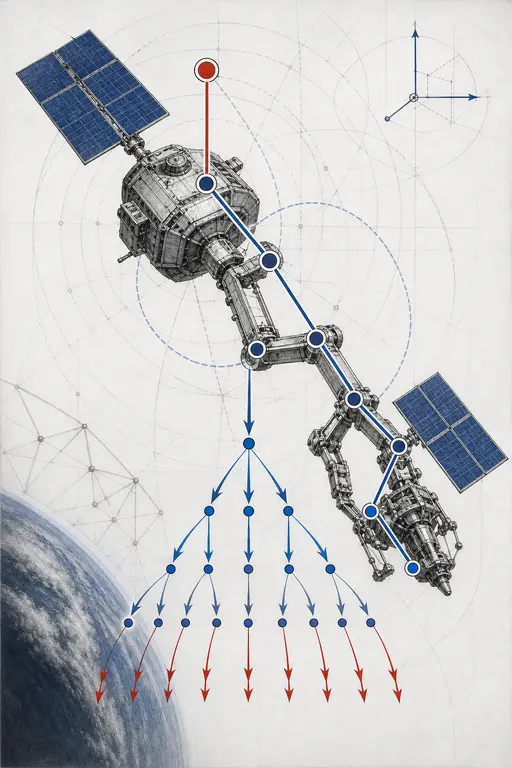
Second of a two-part paper deriving O(N) recursive algorithms (Newton-Euler, Lyapunov/Riccati factorizations) for multibody dynamics from the graph-theoretic spatial kernel/operator (SKO/SPO) models built in Part I.

Builds port-Hamiltonian systems on open directed graphs via Dirac structures, unifying mass-spring-damper networks, spatial mechanisms, hydraulic networks, and consensus dynamics under one compositional geometric framework.

A textbook introducing applied category theory (orders, monoidal categories, operads, sheaves, etc.) through seven worked "sketches" connecting math to systems modeling.

Presents Beautimeter, a GPT-based tool that scores buildings and urban scenes against Christopher Alexander’s 15 properties of living structure to assess their coherence and beauty.
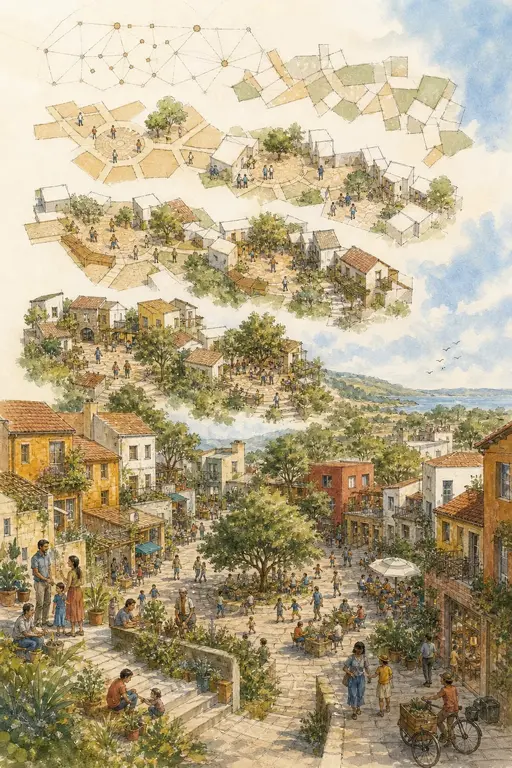
Argues that living neighborhoods arise from generative codes: ordered, participatory steps that let buildings and public spaces unfold from local people, land, and context.

Recasts geography around an organismic view of space, using scaling and spatial dependence to understand—and deliberately create—places with greater living structure.

Proposes harmony-seeking computation as a creative process that repeatedly strengthens latent centers in a configuration while preserving and deepening the larger whole.

Measures an image’s structural beauty by recursively extracting its nested substructures, revealing a compact hierarchy that also captures visual saliency.

Proposes a quantitative measure of structural beauty based on how many substructures an image contains and how strongly they form a hierarchy across scales.

Explains structure-preserving transformations: incremental changes that extend the centers and relationships already present in a place rather than weakening its wholeness.

Gabriel's slide essay relating poetry's formal order to Christopher Alexander's ideas of generative structure, exploring how constraint and pattern produce living order in creative work.

Models spatial wholeness as a hierarchical graph of mutually reinforcing centers, using PageRank and scaling depth to quantify the life of parts and wholes.
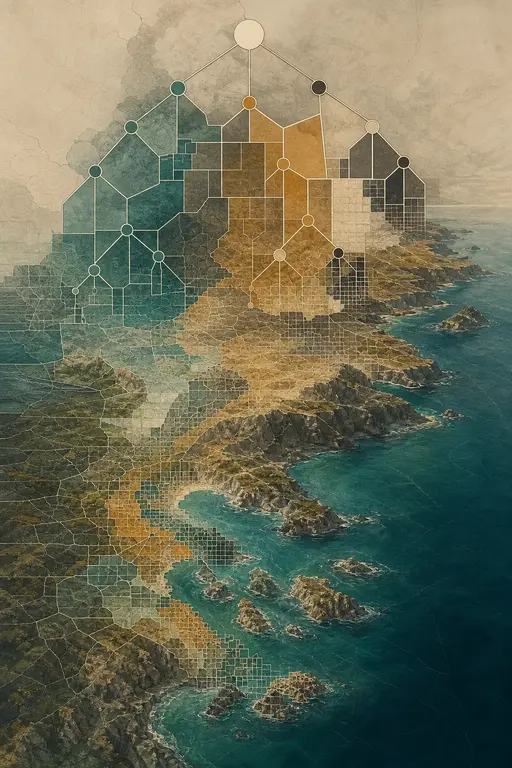
Formalizes partitions as tree-structured cognitive devices projected onto reality, then classifies how accurately, structurally, and completely their cells recognize objects, with applications to cadastral and geographic data.
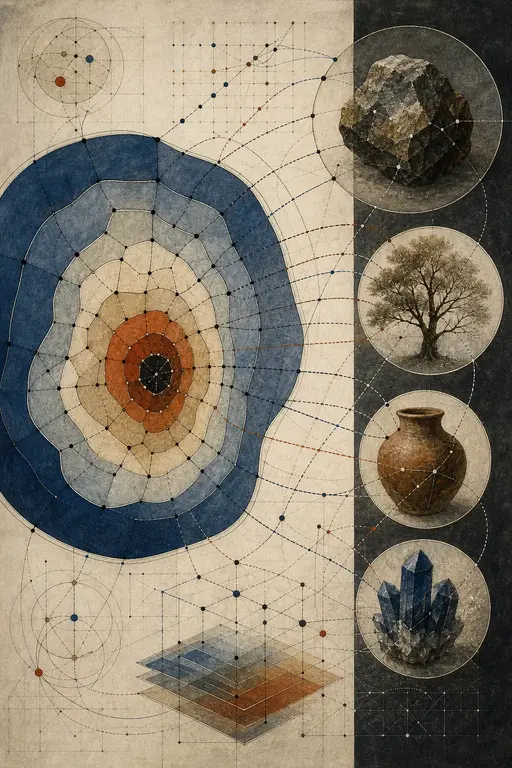
Formalizes granular partitions as hierarchical cell systems projected onto reality, combining cognitive selectivity with mereological structure for naming, classifying, mapping, and representation.

Models fiction, blueprints, simulations, and other information about unreal entities through logical combinations of actual classes, avoiding commitments to nonexistent dummy instances.

Critiques the idea that first-order logic reveals reality’s ontology, tracing its atomism, timelessness, Booleanism, and reductionism before proposing a six-category ontology and an enhanced Davidsonian formal language.

Extends the critique of fantology through default ontologization, arguing that Quine’s canonical notation is incoherent about classes and excludes intentional phenomena and distinct modes of existence.
Defines agglomerations as geographically dispersed yet unified aggregates—populations, cultures, organizations, and diasporas—and develops a realist mereotopology for their boundaries, identity, and change.

Integrates anatomy and physiology by modeling the body as a nested spatial-functional hierarchy whose parts are demarcated as system elements through the functions they bear and realize.

Reconstructs and extends the Brentano–Chisholm mereotopology in which dependent, coincident boundaries account for contact and the continuum across points, lines, surfaces, and bodies.

Defines a capability as a disposition in whose realization an organism or group has or had an interest, placing capabilities between dispositions and functions in Basic Formal Ontology.
Explains how context-sensitive, coarse-grained partitions guide reference and perception while preserving transitive parthood and distinguishing fiat demarcations from boundaries grounded in reality.

Reconstructs Aristotle’s categories as the philosophical basis of BFO, extending the ontological square with processes into a six-category framework for continuants, occurrents, dependence, and multiple scientific granularities.

Extends Basic Formal Ontology to scientific process data through process profiles—quality, rate, and cyclical aspects that ground measurements, time-series graphs, and representations of dynamic systems.

Shows how diagrams and evolving networks of documents mesh plans, obligations, and specialized labor to enable coordinated collective action beyond the limits of linear text.

Argues that mountains are object-like in everyday thought but elevation fields in environmental science, motivating a geospatial ontology that supports both perspectives.
Updates the distinction between human-demarcated fiat boundaries and physically grounded bona fide boundaries, tracing its uses in geography, property, ecology, and Basic Formal Ontology.

Develops an ontology of token niches as tenant–medium–retainer structures, using physical and fiat boundaries to explain environmental fit, protection, movement, and niche construction.

Extends mereotopology with layers that distinguish material objects, holes, and processes from the spatial and spatiotemporal regions they occupy, supporting dynamic geospatial reasoning beyond static map overlays.
Shows how legal decisions, plans, historical reasoning, and language create fiat spatial and spatiotemporal entities, then draws limits and practical lessons for ontology-supported AI.

Develops an ontology of spatial regions and boundaries, arguing that political territories are historically created fiat objects through performative maps while also recognizing vague, overlapping, and incomplete geographic objects.

Reconstructs naïve physics as a realist ontology of the common-sense world—objects, processes, stuffs, boundaries, media, and values—drawing on Gestalt psychology and phenomenology to broaden AI’s set-theoretic models.

Argues for a scientific ontology of the qualitative common-sense world, using morphological discontinuities to connect physical substrates, sensible qualities, Aristotelian categories, and ecologically constrained cognition.

Extends Aristotelian substance–accident ontology into a realist theory of behavioral settings and ecological niches as nested, bounded wholes in which organisms, objects, and activities mutually fit.

Clarifies BFO’s material entities by distinguishing objects, aggregates, and fiat object parts, and analyzes objects through causal unity by covering, physical forces, or engineered assembly without claiming exhaustivity.

Provides a social ontology of credentials as portable, inspectable institutional documents that certify identity or status and give bearers the practical deontic power to exercise rights, with a typology of their forms and functions.
Builds a typology of spatial boundaries around the fiat–bona fide distinction, applying it to maps, political and property divisions, scattered objects, linguistic framing, and truthmakers.
Sets a research agenda for geospatial ontology, linking formal accounts of geographic objects, processes, scale, and vagueness to human concepts, interoperable data, and ontology-driven GIS.

Proposes linked upper ontologies for common sense, physics, and mathematics, arguing that classical models connect real magnitudes to mathematics whereas modern physics relates measurements to entities lacking commonsense universals.
Argues that geographic kinds are intrinsically spatial and boundary-centered, requiring mereology and topology to connect physical reality, cultural categorization, cognition, and GIS representation.

BFO's bicategorial framework: SNAP snapshot ontologies of continuants and a SPAN ontology of processes in spacetime, linked by trans-ontological relations to capture change — demonstrated on the ontology of geodynamics.

Develops a formal ontology of token niches as tenant–medium–retainer structures, extending static organism–environment fit into a dynamic account of vacant niches, movement, interaction, and niche construction.
Argues that modern ideals of compact, contiguous national territory help drive conflict, and proposes perforated, non-contiguous, and geometrically flexible borders as alternatives to displacement and ethnic cleansing.

Builds a sound S4-style modal logic for labeled, typed granular partitions, modeling refinement and cross-partition counterparts so differently selective views can reason about the same mereologically structured reality.
Defends Gibsonian ecological realism: organisms directly perceive affordances in physically real niches, while granular partitions show how different species inhabit perspectives on one world, not separate constructed worlds.
Generalizes Alberti’s perspectival grid into a realist theory of projection: pictures, maps, names, concepts, and databases are “true grids” when their cells preserve relevant structure and refer transparently to reality.

Uses mereotopology and Gibsonian ecology to treat perception and language as carving transient fiat boundaries in reality, defining a judgment field as the truth-making portion of the world selected by a true sentence.
Formalizes vague reference as multiple crisp candidate referents within granular partitions, then explains approximation as using familiar spatial or temporal reference grids to constrain vagueness without truth-value indeterminacy.

Derives a non-greedy pretty printer that optimizes for the shortest valid layout, supports arbitrary subdocument alignment, and runs linearly in the size of its output.

Introduces an expressive pretty-printing language and a formally verified, practical printer that selects optimal layouts using customizable cost objectives while remaining efficient on real-world formatters.

A production breakdown of Horizon Zero Dawn’s vegetation pipeline, covering global wind simulation, layered foliage motion, coverage-preserving alpha mipmaps, shading, asset LODs, placement, and cascaded shadows.

Defines explainable AI for game designers, mapping co-creative systems by their explainability, initiative, and domain overlap so explanations serve concrete design tasks.
Infers playable jump physics from generated platformer levels, including hybrid physics models for levels that blend the geometry and style of multiple games.

Explains Ghost of Tsushima’s compute-driven grass pipeline, from tiled placement and culling to indirect drawing, cubic Bézier blade geometry, variable LOD, wind animation, and material shading.

Develops hashed alpha testing, a stable quasi-random thresholding method that preserves distant alpha-mapped foliage and hair while controlling flicker, anisotropy, and interactions with TAA and alpha-to-coverage.
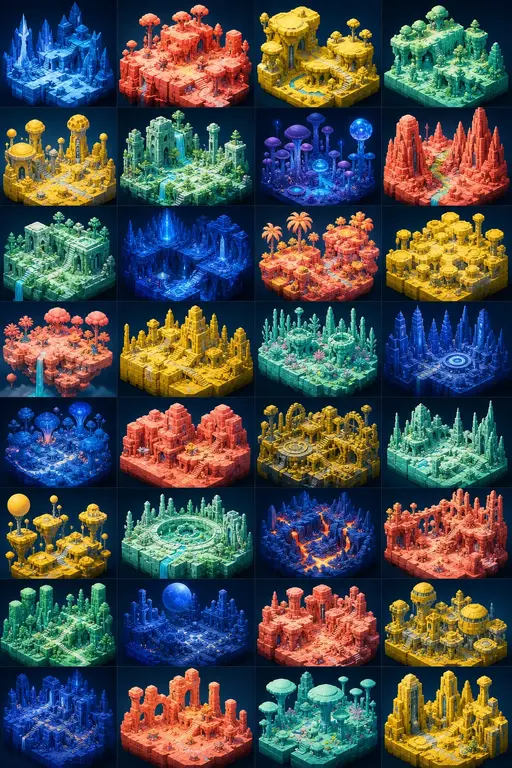
Argues for quality-diversity algorithms in procedural generation, producing broad collections of varied, playable content while exposing the design space for exploration and co-creation.

Defines and surveys PCGML: generating functional game content directly from models trained on existing examples, with uses spanning creation, completion, repair, critique, and compression.
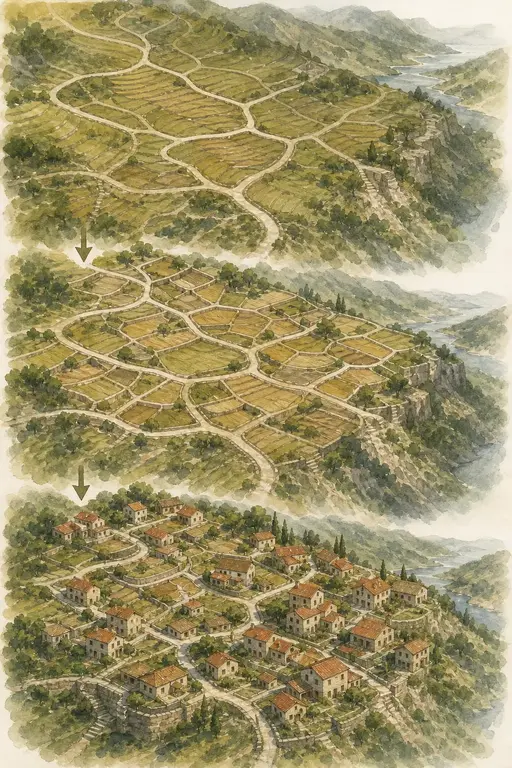
Presents a three-stage procedural model that grows terrain-responsive village roads and settlements, partitions land into plausible parcels, and generates slope-adapted buildings with open shape grammars.

Introduces a GPU work-graph pipeline that generates, animates, edits, and continuously LODs detailed seasonal trees every frame, replacing gigabytes of baked geometry with kilobytes of parameters.

Presents a foundational pipeline for authoring plant ecosystems through terrain design, ecological simulation, procedural plant models, approximate instancing, and efficient rendering of billion-primitive scenes.

Combines detailed z-field trees with terrain shader-maps to render immense forests in real time, preserving sun, sky, canopy, and ground-lighting effects through seamless, scale-consistent transitions.

Renders every grass blade as responsive tessellated geometry on arbitrary 3D surfaces, with per-blade wind, gravity, and collision physics plus aggressive culling that retains dense fields in real time.

Integrates procedural generation and validation in an endless runner, using aerial and ground agents to detect blocked or unnavigable content before the player reaches it.

Distills three requirements for industry-friendly co-creative PCG tools: preserve designer control, keep feedback loops short, and fit into existing production pipelines.

Generates near-optimal racing trajectories quickly by alternating between a minimum-time speed profile and a convex path update that reduces curvature.
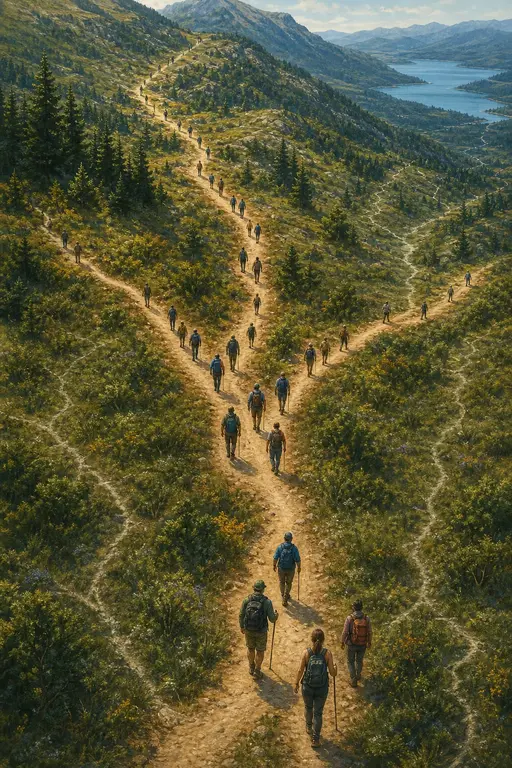
Models trail systems as self-organization: walkers reinforce attractive routes while unused traces fade, producing dendritic ant trails and low-detour pedestrian networks.

Lets designers generate and edit large street networks through tensor fields, combining procedural speed with brush-like global and local control over street patterns.
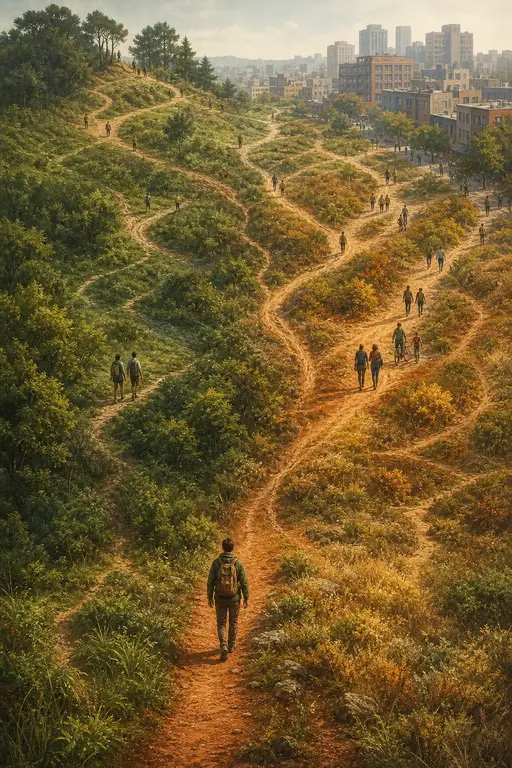
Shows how pedestrian trails emerge through feedback between destination-seeking walkers, existing paths, and vegetation recovery, yielding a compromise between directness and shared infrastructure.

Extends the active-walker model to steep terrain, explaining zigzag mountain trails through slope avoidance, directional persistence, and mutual reinforcement by ascending and descending walkers.
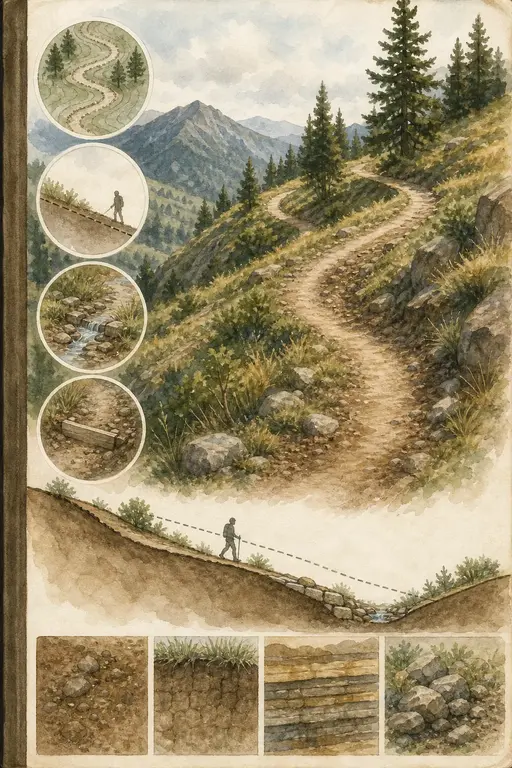
A field-oriented guide to durable trail design, emphasizing curvilinear alignment, natural drainage, sustainable grades, control points, and close reading of landform and soils.

Automatically routes and constructs roads with an anisotropic shortest-path method that weighs slope and obstacles while treating surface segments, bridges, and tunnels consistently.

Argues that Minoan peak sanctuaries were chosen for visibility and proximity to local settlements, forming a beacon-like sacred network whose contraction tracked settlement abandonment rather than cultic collapse.

Adds reinforcements to live sequence charts and BPJ so scenario-based programs can learn from their environment, specifying goals to pursue and scenarios to avoid, with modular learning decompositions.

Position paper on modeling emergence, rule composition, and networked interactions in complex reactive systems, introducing "unmodeling"—explicitly excluding entities and behaviors from model execution.

Distributes scenario-based models by replicating the full specification on every component and projecting it per component, mimicking centralized behavior while sharply reducing synchronization.

Extended methodology for combining LLM chatbots with scenario-based modeling: iterative generation of stand-alone scenarios checked by analysis and human review, framed as a step toward Wise Computing.
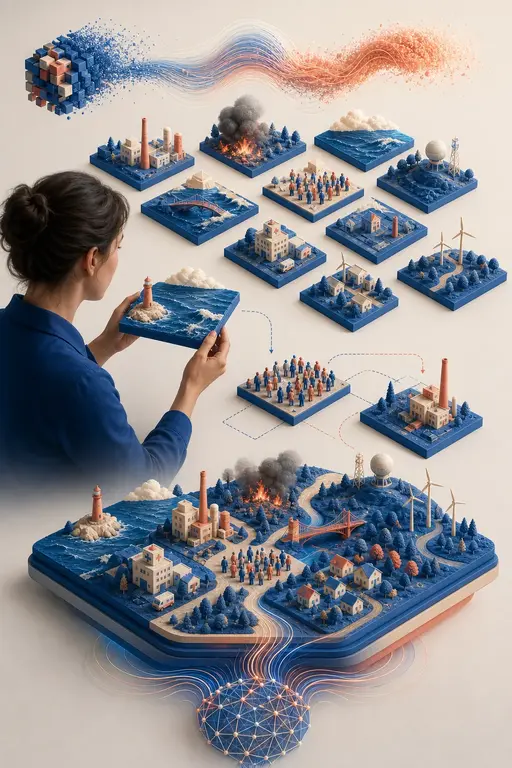
Outlines a structured method for using generative-AI chatbots in modeling: iteratively generate scenario-based model fragments, then analyze and inspect them to converge on an accurate system model.

Introduces model-based trace visualization and exploration for reactive systems, using scenario-based (LSC) abstractions and the Tracer prototype, demonstrated on a PacMan game.

Proposes eager execution for behavioral programs: fast b-threads run ahead when synchronization outcomes are predictable, improving performance, modularity, and distributability, shown in a C++ BP framework.
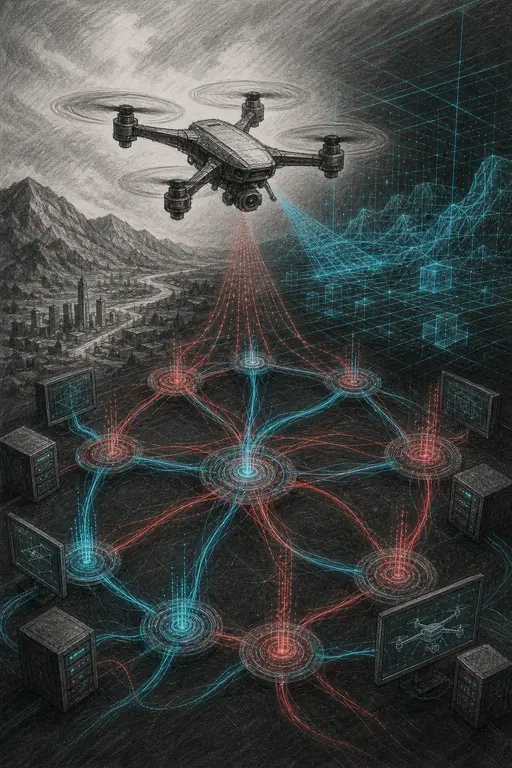
Extends behavioral programming to distributed architectures: b-threads as Erlang processes, eager execution to relax synchronization, and modular distributed execution, demonstrated on simulations and a quadrotor.
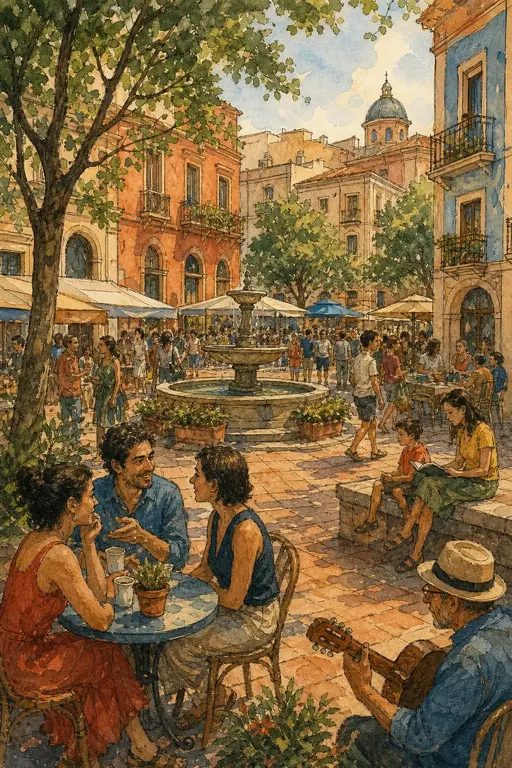
Kohr's essay arguing that cities exist for convivial life rather than economic function, and that human-scale size is what lets a city serve as a centre of leisure, culture, and encounter.
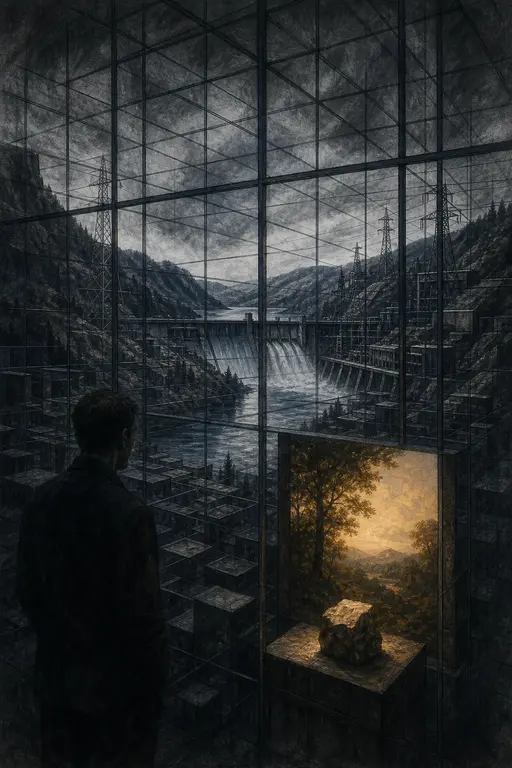
Heidegger's essay on the essence of technology as Enframing (Gestell), a mode of revealing that reduces the world to standing-reserve, and on art as a possible saving power.

A GPU framework for routing surface flow through terrain and its depressions fast enough to make erosion, river, lake, and ecosystem simulations interactive.
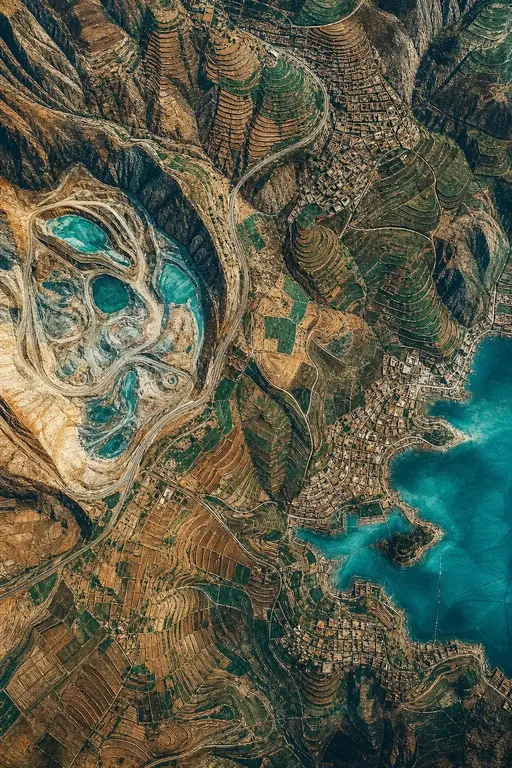
Integrates geomorphology, archaeology, and high-resolution remote sensing into a framework for reading anthropogenic landforms as landscape-scale sociocultural fingerprints.

Generates large, controllable mountain terrains by coupling user-painted tectonic uplift with fluvial erosion, then turning the resulting stream graph into detailed landforms.
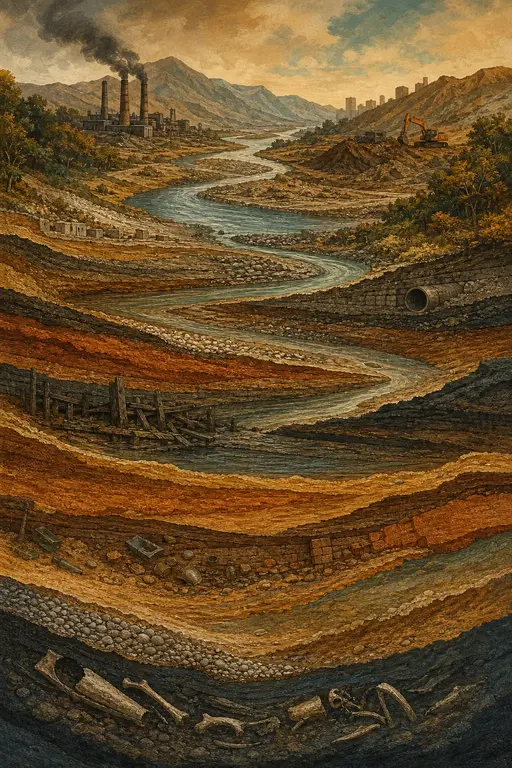
Broadens legacy sediment to episodically produced anthropogenic alluvium and colluvium, and explains its deposition, storage, and remobilization through sediment delivery–transport capacity dynamics.

Turns the stream power law into an interactive terrain tool, replacing thousands of erosion time steps with analytical solutions and a direct control for landscape age.

Introduces Priority-Flood, a simple, optimal algorithm that removes drainage-blocking depressions from elevation models and can also derive watersheds and flow directions.

Builds editable, animated riverscapes from bare terrain by carving hydrologically plausible channels and blending real-time procedural water primitives instead of simulating fluids.
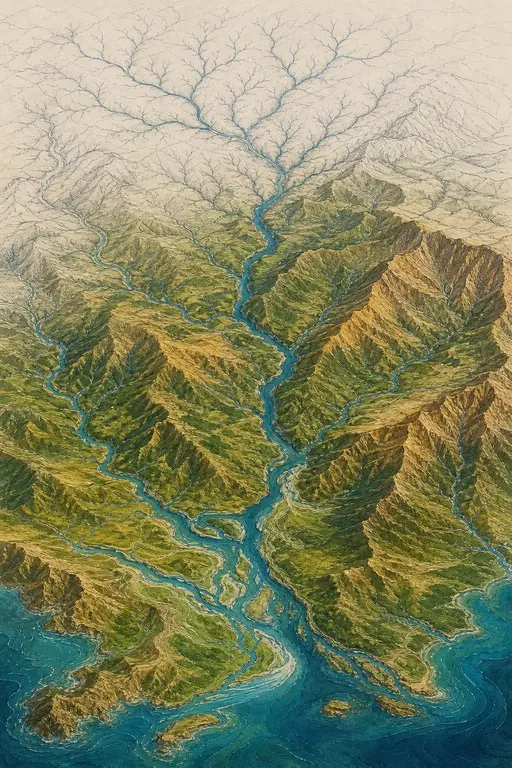
Generates controllable, multiscale terrain from a sketched drainage network, representing rivers and landforms as an editable hierarchy of continuous procedural primitives.

Renders particle-based water and volumetric foam in real time using perspective-aware surface smoothing, physically guided foam formation, and layered depth compositing.

Surveys ocean graphics from spectral deep-water models to near-shore fluid simulation, then covers the foam, spray, and light transport needed for convincing rendering.

Combines a 2D Navier–Stokes solver, hydrostatic pressure columns, and advected procedural textures to render detailed, terrain-responsive rivers at real-time frame rates.

Advects fluid textures with deformable particle grids, preserving both the input texture’s visual spectrum and exact motion along the velocity field without cumulative stretching.

Adds real-time overturning waves to shallow-water heightfields by detecting steep fronts and spawning connected particle sheets that collapse into splashes and foam.

Builds a real-time rendering pipeline for shallow-water simulations, adding fine surface detail, advected foam, photon-based caustics, and screen-space reflection and refraction.

Renders branching river networks efficiently with quadratic Bézier curves, GPU distance fields, and streaming normal maps instead of dense geometry or particle simulation.

Dynamically switches river-wave models by viewing distance, preserving nearby reflection and wave detail while retaining wind-driven motion across the full landscape.

Animates rivers across vast terrains by computing steady flow locally and advecting fine surface detail only where visible, at a screen-space sampling density.

Uses a spectrally controlled halftone mask to make texture-based ocean foam dissipate as clumped bubbles that pop, rather than merely fading transparently.
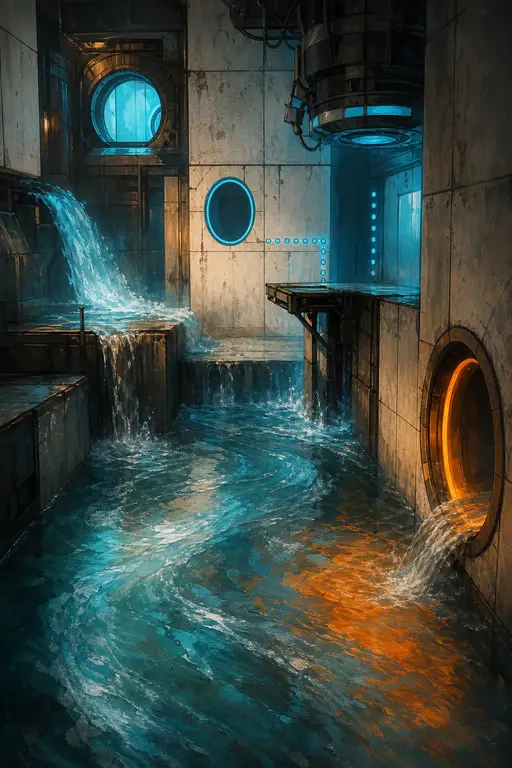
Explains Portal 2’s production-friendly water shader: artist-painted flow maps advect layered normal maps, while offsets and noise suppress repetition and pulsing on limited hardware.

Represents water waves as spatially varying directional amplitudes, enabling vast interactive simulations with fine detail, moving obstacles, solid coupling, and direct artistic control.