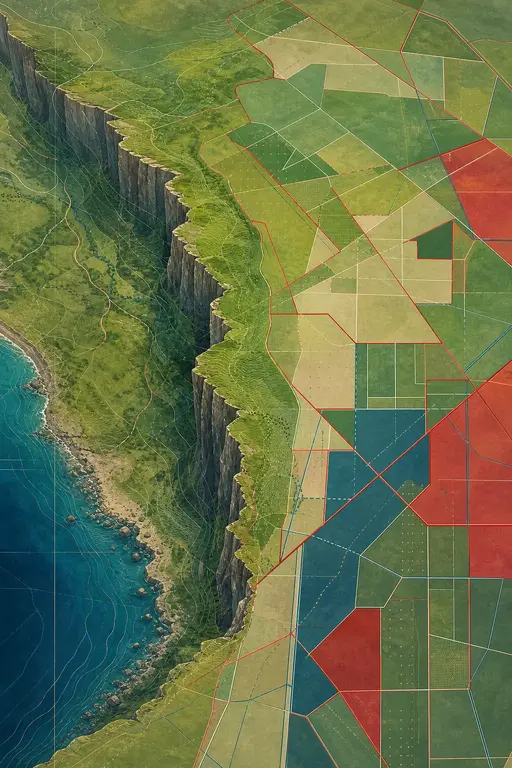
Drawing Boundaries
1. DRAWING BOUNDARIES
Uncorrected preprint of chapter appearing in T. Tambassi T. (ed.), The Philosophy of GIS, 2019, New York: Springer, 137-158
Barry Smith
1.1. Abstract
In “On Drawing Lines on a Map” (Smith, 1995) I suggested that the different ways we have of drawing lines on maps opens up a new perspective on ontology, resting on a distinction between two sorts of boundaries: fiat and bona fide. ‘Fiat’ means, roughly: human-demarcation-induced. ‘Bona fide’ means, again roughly: a boundary constituted by some real physical discontinuity. I presented a general typology of boundaries based on this opposition, and showed how it generates a corresponding typology of the different sorts of objects which boundaries determine or demarcate. In this paper I describe how the theory of fiat boundaries has evolved since 1995, how it has been applied in areas such as property law and political geography, and how it is being used in contemporary work in formal and applied ontology, especially within the framework of Basic Formal Ontology.
1.2. Key words
ontology, geospatial information science, spatial boundaries, fiat boundaries, fiat objects, truthmakers
1.3. 1. Introduction
In “On Drawing Lines on a Map” (Smith, 1995) I described an approach to ontology of reality resting on the thesis that extended entities can have boundaries of two different sorts. On the one hand there are what we might call bona fide boundaries, which correspond to physical discontinuities of the sort illustrated by coastlines or the surface of your skin.1 On the other hand are fiat boundaries, which are boundaries introduced in the absence of physical discontinuities, for example the boundary of Utah or the boundary through your body separating your upper from your lower torso.
The idea of such a distinction was inspired by the theory of boundaries and the continuum sketched in Brentano (1988) and in Chisholm (1989). Both Brentano and Chisholm recognized that there is something problematic in treating a continuum as a collection (set, class, aggregate) of non-continuous points or elements. Each continuum is, rather, ontologically prior to the boundaries or cuts that we may make within its interior. Such cuts are, by definition, not present in the continuum itself. Rather, they are added, for example through an act of demarcation. A formal theory of boundaries and the continuum was developed in this light in my paper in the Chisholm volume of the Library of Living Philosophers (Smith 1997), and this led in turn to the formal theory of bona fide and fiat boundaries presented in Smith and Varzi (1997, 2000).
Fiat boundaries may lie entirely skew to all boundaries of the bona fide sort (as in the case of the boundaries of Utah and Wyoming). They may also (as in the case of the boundaries of Indiana and Pennsylvania) involve a combination of fiat and bona fide portions; or they may be constructed entirely out of bona fide portions which, because they are not themselves intrinsically connected, must be conjoined via a fiat boundary (Smith, 2007).
Once fiat boundaries have been recognized, we can apply the fiat-bona fide dichotomy also to the corresponding (bounded) entities.2 Fiat entities – as for example in the case of parcels of real estate – are distinguished by the fact that they exist only because certain fiat boundaries exist. In some cases, this will reflect some specific human decision. In other cases a fiat boundary will exist not in virtue of some specific human decision but rather in reflection of the physical properties of the object itself.3 That fiat part of a mountain which is above 500 feet above sea level exists independently of any specific contour map, and independently of the institution of contour maps.
We can draw fiat boundaries also in the temporal realm to yield fiat processes: the Renaissance, the Millennium, the Second World War, the Reagan Years, my
1 I am grateful to Thomas Bittner, Berit Brogaard, Roberto Casati, David Mark, Alan Ruttenberg, Andrew Turk, Achille Varzi, Laure Vieu, Lars Vogt, and Wojciech Zelaniec for many helpful contributions.
2 On the use of ‘fiat entity’ rather than ‘fiat object’ see the section on Basic Formal Ontology, below.
3 In a series of papers, beginning with (Vogt, et al., 2011), Lars Vogt and his collaborators have presented a powerful critique of the conception of fiat boundaries as originally formulated in “On Drawing Lines on a Map”, emphasizing above all the need to modify the assumption that fiat boundaries go hand in hand in every case with human decision or demarcation.
childhood, and so forth. All of these are perfectly objective sub-totalities within the totality of all processes making up the history of the universe, even though the spatial reach, as well as the initial and terminal boundaries of, for example, the Second World War were decided (in different ways) by fiat.
The examples of fiat entities mentioned above are all cases where proper parts are delineated or carved out (by fiat) within the interiors of larger bona fide wholes. They are examples of entities created by moving from the top (or middle) down. But we can also proceed from the bottom up, by constructing higher-level fiat objects out of lower-level bona fide objects as parts. This is because, while bona fide entities such as tables, apples, persons, planets, are unitary and thus connected, fiat entities may be scattered; they may be such as to include separate bona fide objects as parts (Smith 1999). Polynesia is a geographical example of this sort; other examples might be: the Polish nobility, the constellation Orion, or the species cat. Such higher-order fiat object aggregates may themselves be unified together into further fiat entities (say: the Union of Pacific Island Nations). The fiat boundaries to which higher-order fiat entities owe their existence are the mereological sums of the (fiat and bona fide) outer boundaries of their respective lower-order constituents.4
1.4. 2. Fiats Perceptual and Ecological
Are entities of these fiat sorts of ontological significance? Can basic principles of metaphysics really turn on the rather elaborate beliefs and conventions that human beings have evolved in relation to place, space and politico-administrative jurisdiction? To see why these questions must be answered in the positive, consider what happens when two political entities (nations, counties) or two parcels of real estate lie adjacent to one another. The entities in question are then said to share a common boundary. This sharing of a common boundary is a peculiarity of the fiat world. For when two bona fide objects converge upon each other, for example people shaking hands, then what happens physically in the area of apparent contact has to do first of all with a compacting of molecules on either side, and ultimately with aggregates of sub-atomic particles whose location and whose belongingness to either one or other of the two bodies are only statistically specifiable. Genuine coincidence of bona fide boundaries is thus impossible, if ‘coincidence’ means: identity of spatiotemporal location.5 To see what is involved here we note first of all that in the geographical realm (or in other words on the geographic level of granularity) – for example in the geographic region where a
4 Compare Bittner and Smith (2001, 2003, 2003a) on the theory of granular partitions.
5 Details are provided in Smith and Varzi (2000), which sets forth the formal differences between the coincidence of boundaries in the fiat realm and the mere proximity of boundaries which is achievable in the realm of physical bodies.
coastal territory meets the sea – we draw fiat boundaries, even though that are delineated not by sharp outer boundaries but rather by boundary-like regions which are to some degree indeterminate. The boundary between two hands in a handshake is a boundary of this sort.
We can draw in this connection on the work on visual perception of the ecological psychologist J. J. Gibson, who takes as his starting point not internal visual images nor retinal excitations but rather the entities out there in the world which are the targets of perception. As Gibson writes:
We are tempted to assume ... that we live in a physical world consisting of bodies in space and that what we perceive consists of objects in space. But this is very dubious. The terrestrial environment is better described in terms of a medium, substances, and the surfaces that separate them (Gibson 1979: 16).
Here substances are stuffs – rock, soil, sand, oil, wood, the tissues of animals. They are all more or less resistant to deformation and penetration by solid bodies and more or less permanent in shape, and they are all generally opaque. Media, in contrast, such as air and water, are relatively insubstantial, and solid bodies can move through them without much resistance. Surfaces, finally, separate media from substances and they separate substances from each other where they come into contact (Stroll, 1988: 126)
The combinations of medium, substances and surfaces that we experience exhibit what Gibson calls ‘affordances’, which he defines as ‘what the environment offers the animal, what it provides or furnishes, whether for good or ill’ (1979: 127), as a chair affords sitting, a staircase affords climbing, or an angry bear affords fleeing.
Affordances involve in every case a combination of bona fide and fiat entities. A fiat boundary is created when a light casts a shadow across a part of your cave, or when an animal looks up as you cross into its territory. Affordances may involve what we might call negative entities – holes, cavities, openings (Casati and Varzi 1994). A tunnel, for example, is bounded physically by its walls, floor and roof; at its entrance and exit, however, it must make do with fiat boundaries. There is a tunnel through your body that passes from the oesophagus through the stomach and on to the small and large intestines. These various parts of the tunnel are separated in virtue of bona fide boundaries founded in the different microscopic structures of the different portions of the tunnel lining. But the tunnel itself is continuous, and so the boundaries separating the successive subtunnels within the tunnel are fiat in nature.
Varzi (2017) presents the ingredients of a view according to which reality is one single continuum, so that all boundaries are fiat in the sense that all boundaries are human induced. A more extreme view would have it that no entities are fiat in nature. Rather, our talk of what we are here calling ‘fiat entities’ is, precisely, talk and thus of no further ontological significance. Some friends of what we might think of as ‘ultimate physics’ hold that there are bona fide objects – ultimate atoms of reality – but that these exist on a level way beneath our everyday ken. They would thus reject candidate meso- and macroscale bona fide objects such as people and planets, viewing these, again, as a matter of mere façons de parler.6
1.5. 3. The Linguistic Windowing of Reality
There are also fiat entities which arise specifically in virtue of the groupings and refinings which are involved in our use and understanding of language. This occurs in a two-fold process. On the one hand, linguistic entities such as spoken words and sentences are themselves processes demarcated in fiat fashion out of concrete sound-material that is in itself not cleanly separated out into linguistic units via discontinuities in the flow of sound. In addition, the flow of sound and of sound production is fused in one or other way with underlying mental and neurological accompaniments. On the other hand, external reality, too, is tailored, or pared down by fiat, in order that it will fit our linguistically generated windows of salience. Thus if I say, truly, ‘John built mud pies in the sand’, then the real-world target of my utterance is a certain portion of reality7 involving John, some sand, a complex plurality whose constituent unitary parts are comprehended through the phrase ‘mud pie’. If I say, truly, ‘John shocked Mary’, then the real-world correlate of the verb of this sentence is a complex dynamic affair (a fiat process, or what is elsewhere called a ‘process profile’ (Smith, 2012)) that is comprehended through the transitive verb ‘shock’. Participants in the process involve John, Mary, some utterance or gesture on the part of John, and some mental process on the part of Mary that is caused by this utterance or gesture and has both Mary and John as its targets.
The way in which natural language contributes to the generation of fiat boundaries can be illustrated in relation to the correlated linguistic phenomena of mass versus count and verbal aspect (Galton, 1984; Mourelatos, 1981).
When I point towards a cattlefield and assert ‘there is cattle over there’, then the target of my assertion differs from my target when I assert ‘there are cows over there’. The underlying real bovine material is in both cases the same, but I impose different sorts of boundaries on this material in the two cases.
Verbal aspect has to do with the ‘internal temporal constituency’ of the events
6 See Davies (2018) on the metaphysical implications of the fiat/bona fide distinction.
7 Ceusters & Smith, 2015.
towards which our empirical judgments are directed (Comrie 1976). Consider the concrete factual material that is John kissing Mary on a given occasion. In this factual material, here again fiat boundaries can come to be drawn by language in a variety of ways. It can be comprehended as: ‘John is kissing Mary’, ‘John is repeatedly kissing Mary’, ‘Mary is constantly being kissed by John’, ‘Mary has been being constantly kissed by John since 1884’, and so on (Thomsen and Smith, 2018).
Such carving out of linguistic fiat objects is in part a matter of simple grouping together, for example, through the use of plural referring expressions such as ‘Hannah and her sisters’ or ‘Siouxsie and the Banshees’ (Ojeda 1993). But it is in part also a matter of windowing or foregrounding (Talmy 1996). If I point to a group of irregularly shaped bumps in the sand and say ‘dunes’, then the real-world correlate of my expression is a complex plurality (a higher-order fiat object with non-crisp boundaries) divided, via the general type dune, into constituent non-crisply delineated parts (Smith 1987). Cognitive linguists such as Talmy (1995, 1996) and Langacker (1987/1991) have rightly emphasized the degree to which language effects subtle articulations of this sort.
Another variety of fiat boundary-creation is effected through our use of expressions such as ‘this’ and ‘that’ in relation to objects in space. This involves in each case the drawing of a transient, imaginary boundary, lying in the region in front of the speaker, which is such that the objects labeled ‘this’ and ‘that’ lie on opposing sides of the boundary. The use of ‘here’, similarly, involves the creation of an ephemeral fiat boundary comprehending a roughly spherical volume of space around the speaker, a volume whose size, shape and location, and sometimes also degree of crispness (Smith and Brogaard, 2003) are contextually determined. Transient boundary-creation of this sort is effected in the same way independently of order of magnitude, from the tiniest (‘this flea’) to the grossest (‘that empire,’ ‘that galaxy’).
As Talmy has shown (1995), boundaries are at work also in cases of the following sort:
I offered Agnes the book [creates a virtual sphere around the recipient].
She accepted the book [Agnes allows the sphere to be broken].
She rejected the book [Agnes maintains the sphere unbroken].
which involve the creation of non-physical paths and boundaries of a range of different sorts.
It is important to realize that the fiat boundaries drawn in cases such as this are drawn in the world of bona fide objects. While it is true that all objects which we grasp linguistically are grasped through our linguistically expressed concepts, we should not move from there to: all objects which we grasp linguistically exist only in virtue of our linguistically expressed concepts.8
Everyday objects and processes are described by cognitive linguists such as Talmy (1995) and Lakoff (1987) as existing in the ‘conceptual realm’. Even space itself is often described by Talmy as a mere ‘conceptual domain’ in a way that implies that, in the absence of concept-using subjects like ourselves, space would not exist. What I am proposing here, however, is that the fiat boundaries induced through natural language are of a piece with geographical fiat boundaries. This makes it clear how Talmy’s position is to be corrected: the fiat boundaries to which reference is constantly made in our natural language utterances are not in any sense in our heads, or in some conceptual sphere. Rather, they are out there in the world. They are not, however, physical in nature. Rather, they are analogous to other ephemeral socio-cultural formations – such as debts, claims, bank balances – entities which are parts of what Frege would call ‘objective’ reality, yet not such as to fall within the domain of physical science (Frege 1884: Ch. 1).
And now, if some fiat boundaries – like the borders of nations or postal districts – are social entities in this sense, then like the latter they will be subject to legal regulations. When the legal system takes up into its orbit a vaguely bounded region (a wetland) or vaguely bounded processes (for example the process of dying) then it characteristically adds a rule that is designed to make the relevant boundary precise. Private property in some jurisdictions extends to the mean low water mark, and for any coastal portion of the United States or Canada there is some legal definition based on mean low, high, average, etc. tide level, as to where private property stops and a commons starts. Definitions are needed also as to how such determinations apply when boundaries cross the mouths of rivers. If the legal system needs to know where the shoreline is in order to regulate access, then it will need to pick some particular stage in the tidal cycle, such as mean low tide level; it thus creates a fiat shoreline that is fixed and reasonably crisp, and this exists as it were alongside the bona fide shoreline that moves with the tides. You cannot see or touch or trip over the fiat shoreline; but the fiat shoreline is there, nonetheless, as a part of reality: if you cross it, you will be fined.
1.6. 4. Truthmakers as Fiat Objects
We can now expand our treatment of linguistically generated fiat boundaries to throw light on the notion of truth as classically understood in terms of a correspondence between a judgment or assertion on the one hand and a certain portion of reality on the other. Reality does not, of course, come ready-parceled into judgment-shaped portions that are predisposed to stand in relations of correspondence of the given sort. The discipline of logical semantics has thus
8 Stove calls the argument in favor of views of this ‘the gem’. See his (1991).
tended to treat, not of truth as such (truth to reality), but rather of truth in a model, where the model is a specially constructed set-theoretic reality-surrogate. The theory of fiat boundaries can help us to avoid the need for this resort to surrogates by allowing us to treat judgment itself as a sui generis variety of drawing fiat boundaries.
True judgments effect a drawing of boundaries that is successful in the sense that it does not conflict with reality. The resultant boundaries themselves are drawn, as already described, in the extended world of genuine objects and associated processes. The fiat entities they circumscribe are typically many-sorted: they include both objects and processes (as the correspondent sentences include both nouns and verbs). Such entities are on the one hand autonomous: that region of reality through which the given boundary is drawn – for example the complex of objects and processes which are involved in John’s kissing Mary – exists in and of itself, regardless of our judging activity, and so do all its constituent sub-regions. The whole itself is however also in a certain sense dependent on our judgment. For in the absence of the judging activity through which the drawing of the fiat boundary is effected, a portion of reality of just this sort would in no way be demarcated from its surroundings. Judgment-shaped portions of reality can in this way exist in reality objectively, and to be precisely tailored to make our judgments true, but they are fiat rather than bona fide in nature.
There is, as Talmy puts it, a windowing of reality that is effected by our uses of language, especially of those descriptive uses of language which are involved when we make true empirical judgments. The ephemeral fiat boundaries effected through declarative sentences are analogous to the ephemeral boundaries of the visual fields associated with our acts of visual perception as described in (Smith, 1999b). Veridical judgments stand to those portions of reality which are their fiat judgment-correlates as acts of perception stand to their associated visual fields.
Each true empirical judgment can be seen as effecting a division of reality in fiat fashion in such a way as to mark out a certain truthmaking region consisting of those entities that are relevant to the truth of the judgment in question. Truth itself can then be defined as the relation of correspondence between a judgment and its corresponding truthmaking region, and a true judgment is in this sense analogous to a map of the corresponding portion of geographic reality.9 A view of truth along these lines rests on an account of the windowing of reality via language that is of a piece with the ecological account of perceptual windowing advanced by Gibson.
1.7. 5. Fiat Boundaries in Feature Spaces
The fiat–bona fide opposition can be identified also in the realm of qualities. We
9 A detailed formal theory of truthmaking along these lines is presented in Smith (1999a).
distinguish first between determinate and determinable qualities, where the former – for example this specific shade of red – are specifications of the latter – for the example the quality red. We can imagine the determinates of a determinable such as color arranged in a quasi-spatial way, as happens in accounts of color- or tone-space (Gärdenfors 2000, Guarino 2013, Johansson, 1989). When an object changes its color continuously, for instance moving through the color spectrum from red to violet as a result of continuous heating, we then draw fiat divisions along this spectrum through our use of color terms, dividing it into red, orange, yellow and so forth. This process is subject to a certain degree of variation in determining where the boundaries are to be drawn, for example, between different cultures and different specialized areas (colours of wine, hair, and so forth).
We draw analogous fiat partitions also in spaces of variation along non-qualitative dimensions, for example in classifying geographic entities such as ‘strait’ and ‘river’ (Mark, Skupin & Smith 2001). The English language might have evolved with just one term, or three terms, comprehending the range of phenomena stretching between strait and river or, in French, between détroit and fleuve. For while the Straits of Gibraltar are certainly not a river, and the Mississippi River is certainly not a strait, things like the Detroit River, the Saint Claire River, the Dardanelles, and the Bosphorus are borderline cases. All are flat, narrow passages that ships can sail through between two larger waterbodies (lakes, seas), and all have net flow through them due to runoff. Is Lake Erie really a lake, or just a wide, deep part of the river-with-five-names that is called the St. Lawrence as it flows into the sea? Well, that depends on what you mean by ‘lake’.
Quine has put forward a radical proposal according to which even classical conceptual distinctions drawn in metaphysics are distinctions of this fiat sort. Consider three scattered portions of the world made up of rabbits, of rabbit stages, and of undetached rabbit parts, respectively. The results of each of these partitions, as Quine sees it, make up when taken collectively just the same scattered portion of the world. The only difference ‘is in how you slice it’ (Quine 1969: 32). What he means, in our terms, is that the conceptual divisions between continuants, stages and undetached parts are mere products of fiat. Since reference is behaviorally inscrutable as concerns such distinctions, Quine concludes that there is no fact of the matter that they might reflect – no fact of the matter on the side of the objects themselves as these existed before they were addressed in our language. Continuants, parts and stages do not differ from each other in virtue of any corresponding (bona fide) differences on the side of the corresponding entities in reality. Rather they differ from each other in the way in which, when asked to count the number of objects in the fruit bowl, you can say either: ‘one orange’, or ‘two orange-halves’, or ‘four orange-quarters’, and so on – and you will give the right answer in each case. The distinctions in question are merely the products of our fiat partitions of one and the same reality.
But note that Quine is being too hasty when he affirms in defense of his thesis of ‘ontological relativity’ that there is no ontological fact of the matter as concerns the reality to which we are related when using singular referring terms. For it follows from his own doctrine that it is a fact of the matter that this reality is intrinsically undifferentiated as far as the mentioned ontological distinctions are concerned. This is just the other side of the coin from the fact that the corresponding boundaries are on his view entirely fiat in nature. This putative ontological fact of the matter, however, faces problems. For it is itself a presupposition of the thesis of ontological relativity to the effect that there are no ontological facts of the matter.
Quine comes close to a view according to which all boundaries on the side of objects in reality are of the fiat sort. Objects of reference, for him, can comprise any content of some portion of spacetime, however heterogeneous, disconnected and gerrymandered this may be. For us, on the other hand, there are some ways of referring to things and processes that track bona fide boundaries in reality and others that do not. It is the job of fundamental science to move us in the direction of such bona fide joints of reality, though even when science has completed this job there will of course still be room for delineations of the lesser sort, which track boundaries – for example of Quebec, of the 70 mph zone on the highway, or of the No Smoking Section of your favorite restaurant – which exist only as a result of our acts of fiat.
1.8. 6. Jeffersonian Fiats
When Jefferson first drew his map of proposed states of the Northwest Territory in 1784 (see Figure 1), drawing off 14 neat checkerboard squares between the boundaries of the Atlantic colonies and the Mississippi River, his result was sufficiently inaccurate that it did not even have the Great Lakes in the right place. In the end, 10 states were nonetheless created in this area, having boundaries that follow Jefferson’s lines in large degree.
Delineations such as these can be effective in creating objects in the geospatial realm only if the pertinent boundaries are, in the jargon of topology, Jordan curves (broadly: the boundary of a geopolitical or administrative entity must be free of gaps and must nowhere intersect itself). They are effected from the top down in the sense that there are no units or elements from out of which the corresponding fiat entities could be seen as being constructed in analogy with the way in which sets are constructed out of their members.

Figure 1: Map of proposed states of the Northwest Territory, drawn by Thomas Jefferson in 1784
This is because geographers deal with regions of different shapes and sizes, and with sub-regions of these regions, and with the ways these regions and sub-regions overlap or fail to overlap (Casati and Varzi 1999). They deal, in other words, with a mereologically-structured world. Some of Jefferson's delineations correspond to bona fide boundaries: river-banks, coastlines, and the like. These are boundaries in the things themselves, and they would exist (and did indeed already exist) even in the absence of all delineating or conceptualizing activity on our or Jefferson's part. Many borders of political and administrative units in the North-American continent correspond to no genuine heterogeneity on the side of the bounded entities themselves.
Often, of course, such boundaries do in course of time come to involve boundary-markers: walls, barbed-wire-fences, border-posts, watch-towers, and the like, and these will sometimes replace what is initially a fiat boundary with something more tangible, something physical. Fiat and bona fide objects are interrelated also epistemologically. Thus in cadastral practice certain objects, for example surveyors' pegs placed to establish a boundary, enjoy a privileged status in determining at later times where the boundary lies. This means that there are laws governing the use of such objects, as also of posts, walls, fences and so forth, as evidence of boundary location, laws for example having the effect of limiting the degree to which walls may be moved when rebuilt. Such laws institute a new layer of fiat boundaries, attached to the primary layer and constituting surrounding fiat zones of tolerance.
But however arbitrary a given geospatial demarcation might be, there are reasons of a non-arbitrary sort why these and those fiat boundaries are created rather than others. Thus it was a complex medley of considerations relating to shipping, trade winds, harbors, climate, markets, and so on, which led our ancestors to create the fiat region called 'the North Sea' in a way which could not just as well have motivated them to create what would have been called, say, 'the Middle Sea' stretching between the Bermudas, the Azores, and Gotland. As already noted, fiat boundaries in general owe their existence not merely to human fiat but also to associated real properties of the relevant factual material (they are functions of affordances, in Gibson's terms). As demarcated in mesoscopic (geographical) reality they are in every case linked to bona fide objects at various scales without which the relevant demarcations could not be effected at all. It is already for this reason a confusion to suppose that all objects (or all mesoscopic objects) might be in some sense of the fiat type. As the reports of boundary commissions make abundantly clear, the very possibility of fiat demarcation presupposes the existence of bona fide landmarks in relation to which fiat boundaries can be initially specified and subsequently re-located.
It is interesting in this respect to consider the question when an imaginary mathematical line (a fiat boundary) was first recognized as a political limit separating two territories. In his The Renaissance Rebirth of Linear Perspective (Edgerton 1975: 115), Edgerton describes how, during the wars of 1420, a longitudinal line was proposed as the boundary between the two states of Milan and Florence. The reference is to the treaty between Filippo Maria and Florence dated February 8, 1420, which designated the ideal line connecting Magra and Panaro as the limit of their respective spheres of influence (which themselves referred back to another treaty, from 1353, where Milan and Florence each agreed to stay out of the affairs of Tuscany and Lombardy). It is however very unlikely that this line was a true boundary between the two territories. Thus the question as to the first genuine geopolitical fiat boundary remains unresolved.
1.9. 7. Vagueness, Gluts, and Intervolvements
As already pointed out, geographical fiat objects will in general have boundaries that involve a combination of bona fide and fiat elements. The shores of the North Sea are bona fide boundaries, but we conceive the North Sea as a fiat object nonetheless, because where it abuts the Atlantic it has a boundary of a non-bona fide sort. The status of the latter is noteworthy in that there seem to be few practical consequences that turn on the issue as to where, precisely, it lies. Political boundaries were once themselves standardly created in places (mountain ridges, middles of rivers, marshes, swamps, deserts) where there is little human activity and thus little chance or occasion to look into their exact location.
Something similar holds also in regard to many geographical boundaries of a non-political sort – for example, the boundary between a hill and an associated valley. The treatment of such cases requires a further opposition between crisp and indeterminate boundaries. Spatial entities such as deserts, valleys, mountains, noses, tails are delineated not by crisp outer boundaries but rather (on some sides at least) by boundary-like regions which are to some degree indeterminate. We here leave open the question whether bona fide reality involves both and scruffy (fuzzy, hazy, indeterminate) entities as part of its ultimate furniture. Here vagueness will be seen as matter of semantics. If you point to an irregularly shaped protuberance in the sand and say ‘dune’, then the correlate of your expression is a fiat object whose constituent unitary parts are comprehended through your idea of what a dune is. The vagueness of this idea is responsible for the vagueness with which the referent of your expression is picked out. And what this means is that each one of a variety of overlapping determinate portions of reality has an equal claim to being such a referent.
The above corresponds to the so-called supervaluationist account of vagueness (Fine 1975; McGee 1997; Varzi 2001), which sees vagueness in terms of precisification, so that to say that a demarcation line is vague it to say that there is a multiplicity of acceptable ways of making it precise. A view along these lines can be sustained only if account is taken of the fact that the assignment of a range of candidate-precisified referents to a given expression is dependent on the context in which that expression is used. This is because the degree of vagueness we can comfortably allow in our delineations varies inversely with the degree to which a given boundary is of practical relevance – and what is and is not of practical relevance is of course such as to vary from one context to another (Bittner & Smith, 2001, 2003, 2003a; Smith and Brogaard, 2003).
When you have a map, and it has a shoreline with ins and outs, and on the water adjacent to one of the ins is a label saying ‘Baie d’Ecaigrain’, it is fairly easy for a human to see where the bay is. The outer boundary of the bay (seaward) is in most contexts irrelevant to action or practice, and thus a wide range of precisifications is allowed. In a context in which regulators have ceded all the islands (or oil) in the bay to some other country, however, a quite different and much narrower range will be required. Human beings can cope quite well with such vagueness of reference and with contextually determined reference shifts, and with different sorts of vagueness along different dimensions – as for instance where a bay is recorded as extending from there to there on the coastline, but as just fading off to seaward. The well-known indeterminations involved for example in establishing the number of lakes in Finland or the length of the coastline of
Norway Sarjakoski, 1996) illustrate the phenomenon whereby the range of admissible precisifications can vary widely – according to the purpose the measurements are being made, the governing regulations or the definitions or the measuring instruments or protocols employed.
We can all agree that mountains, hills, ridges, capes, points, necks, brows, shoulders, heads, knees, shanks, rumps, pockets, fronts, backs, pits are real; and that it is obvious where the top of a mountain or the end of a cape is to be found. The crisply determined features of such entities – for example the heights of mountains – can be looked up in reference books. But where is the boundary of Cape Flattery on the inland side? Where is the boundary of Mont Blanc (we mean the base of the mountain) on the French and Italian sides? (Smith & Mark, 2003)
Modern geopolitical boundaries are distinguished in being infinitely thin (crisp, determinate, precise). Political and legal boundaries must, it seems, enjoy at least ideally and in the long run a geometrical perfection of this sort, which is to say that they must take up no space. For otherwise disputes would threaten to arise in relation to the no-man's-lands that the boundaries themselves would then occupy. If a wall or river separates two distinct portions of land, then either the wall or the river must be split equally down the middle, or it must be assigned as a whole to one or other of the two parties, or it must be declared common property (and then there will exist two infinitely thin boundaries separating each of the two distinct parcels of land from the commonly owned region which divides them).
Each adjacent pair of geopolitical boundaries (say: on the Franco-German border) manifests, in addition, the phenomenon of coincidence of boundaries which are yet not identical. The boundary of France along this border is not also the boundary of Germany: each points inwards towards its own respective territory. Contrast, in this respect, the Western boundary of the old German Democratic Republic or the southern border of the present Turkish Republic of Northern Cyprus: here, exceptionally, no coincident twin was established, since the relevant neighbors did not see fit to institute a boundary of their own.10 Moreover, as the case of Texas and the U.S.A. makes clear, distinct geopolitical boundaries may also coincide from within. That is, they may coincide for a part of their length along which they serve as boundaries on the same side. As a map of the states of the continental U.S.A. makes clear, the modern geopolitical ideal is a world of boundaries which form an irregular tessellation of each geopolitical area, until the boundary of each cell is the tessellation having the topology of a Jordan curve.
There are departures from this ideal of a sort not to be catalogued under the heading of vagueness. First, there are gaps which we have discussed already above
10 Compare the treatment of boundaries of different pleriosis in (Brentano 1988).
in dealing with the no man's lands that have not yet been assigned to one jurisdiction or another. Today, however, almost all gaps have been eliminated via treaties. Gluts are a more intriguing matter. Consider the border between Germany and Luxemburg. Where borders between states usually run down the middle of water bodies, the bed and banks of the rivers Mosel, Sauer and Our belong to both Germany and Luxemburg, which hold them in a condominium, a status which has been shared by all the water bodies forming the boundary between these two countries since 1816, which is the year of the first written agreement on the boundary separating the United Netherlands from Prussia.
An ontological status that is still more problematic is enjoyed by Lake Constance, which forms part of the boundary between Austria, Germany and Switzerland. Lake Constance is an ontological black hole in the heart of Europe, whose territorial status is in seemingly unresolvable limbo. While one part of the lake, Lake Überlingen (which is not truly a lake), belongs completely to Germany, the course of the border in the rest of Lake Constance has not been laid down. For while Switzerland holds the view that the border runs through the middle of the Lake, Austria and Germany are of the opinion (albeit on different grounds) that the lake stands in condominium of all the states on its banks. Hence no international treaty establishes where the borders of Switzerland, Germany, and Austria in or around Lake Constance lie. If you buy a ticket to cross the Lake in a Swiss railway station, your ticket will be valid only to the point in the middle of the Lake where, as the Swiss see it, their jurisdiction ends.
1.10. 8. Scattered Fiat Objects
The drawing of fiat boundaries can create fiat parts within larger bona fide wholes. But it can also, in the manner of Micronesia or Polynesia, create fiat wholes out of smaller bona fide parts. And then, while bona fide objects are in general connected, the fiat objects that are circumcluded by fiat boundaries in this way are scattered entities.
There are also cases where the two distinguished factors – on the one hand the carving out of fiat parts, and on the other hand the gluing together of fiat wholes – operate in tandem, so that geographical objects are created via the fiat unification of disconnected parts within larger wholes, for example in coastal nations in whose territory islands, or portions of islands, are included.
The Holy Roman Empire of German Nations in around 1500 serves as a nice example in this regard. Here 'German Nation' signifies one or other of some hundreds of kingdoms, principalities, duchies, counties (Grafschaften), prince-bishoprics, free cities, and so forth. These were often scattered, which means that they included parts disconnected from each other and embedded in the interiors of other German Nations. Scattered fiat objects of this sort may be intervolved – intercalated inside each other – in a variety of ways. Consider the case of the Belgian enclave of Baarle-Hertog, which is depicted, together with its neighbor, the Dutch community of Baarle-Nassau, in Figure 2.

Figure 2: The Enclaves of Baarle-Hertog and Baarle-Nassau
This Figure represents an area of roughly three square kilometers situated some five kilometers from the Dutch-Belgian border near Turnhout. The lighter shaded areas in the Figure represent the community of Baarle-Hertog. The small darker shaded areas depict the tiny Dutch enclaves of Baarle-Nassau. Each such enclave is surrounded by a portion of Belgian territory, which is in its turn surrounded once more by territory that is Dutch. This peculiar arrangement arose as a consequence of Dutch independence from Spain in 1648, when the Dutch border was defined on the basis of a long-standing feudal provincial boundary, which in turn featured numerous enclaves and exclaves. A strong religious divide between the Netherlands and Spain in 1648, coupled with rural conservatism favoring the status quo, together stymied all governmental attempts to exchange or cede the enclaved lands. The two families of enclaves around Baarle were briefly merged in 1815 with the formation of the United Netherlands at the Congress of Vienna. But with the independence of Belgium in 1830, the old situation was resurrected, and once again ancient provincial limits were used as the international border. Being unable to determine a more rational boundary than those involved in negotiating the 1843 Treaty of Maastricht was forced to resort to the individual determination of national ownership of each of 5732 plots in the two communes, yielding a delineation of the border that survived until 1995, when modern administration, infrastructure and legal systems necessitated an exacting survey which has cemented the existence of the enclaves in the arrangement depicted above.11
1.11. 9. Fiat and Bona Fide Boundaries in the Material Realm
Organisms and cells are marked as fundamental units of biology by the coverings or membranes which extends continuously across their surfaces, albeit with small apertures – such as pores, mouths, nostrils – which allow interchange of substances such as air and food between interior and exterior (Smith & Brogaard, 2003a). Objects of these sorts are thus bounded by bona fide coverings, which are parts of the objects which they bound.12 For organisms in early phases of their lives, complex layered bona fide coverings have evolved with the function of protection, for instance against bacterial invasion, toxins and damage through physical force. The mammalian embryo is protected by the successive layers of (starting with the outermost layer): maternal epithelial covering (the outer protective layer formed by the mother's skin), the uterine wall, the placenta, chorion, and amnion, and ultimately by the outer layer of cells of the embryo itself. The eggshell of a chicken similarly protects the developing chick through an outermost inorganic layer called the cuticle of the egg, inside which is a succession of organic layers including the vertical crystal, and the palisade layers followed by the mammillary cone, external shell membrane, internal shell membrane, and limiting shell membrane (Hinckel, et al., 2012). At the same time some 17,000 pores allow air and moisture to penetrate through these layers into the interior of the egg.
Many other kinds of bona fide objects – including our own planet, starting with the Earth's crust – have exteriors structured in a similar way by a bona fide external layers, coverings or membranes. This holds of many artifacts for instance of automobiles, whose aluminum alloy panels are protected by successive layers of paint designed to protect against weather and UV radiation damage, stone-chipping, and so forth. Layered structures of these sorts are used also for protective purposes in roofs and walls, and also in highways and pavements.13
11 Details are presented in (Whyte 2002). See also Vinokurov (2007).
12 They are 'fiat object parts' in the terminology of BFO.
13 Up to 8 such layers of timber, chalk, stone and other materials were employed already in the construction of Roman roads (Flaherty, 2002, p. 226).
Objects such as lumps of granite do not have coverings or membranes of these sorts. But this does not mean that they lose their status as bona fide objects. Indeed, they are bona fide in just the same sense that physically distinct layers of an epithelium or roadway are bona fide, namely in virtue of the physical discontinuity between them and the substances or media that surround them.
For all the kinds of objects discovered manifest on their outermost surfaces what we shall call an interface. There is an interface between a block of granite and the surrounding air. There is an interface between any two adjacent layers in a multi-layered structure. And there is an interface between an outermost layer and the surrounding medium and between the innermost layer in a protective layered structure and the enclosed medium surrounding the protected organism. Stroll, in his book on Surfaces (1988, pp. 44f.), calls such interfaces ‘Leonardo surfaces’ – drawing on the discussion in Leonardo’s Notebooks of a surface as ‘the common boundary of two things that are in contact’, for example the boundary between the air and sea. For Stroll, as for Leonardo, surfaces are without bulk – as contrasted with the associated bulky portions of matter, which they are the surfaces of. For us here, however, interfaces are not perfectly thin zones at the exteriors of bona fide objects where microparticles may be such that their belongingness to one or other of the interfacing objects is only statistically specifiable.
A general theory such matters is provided by J. J. Gibson in his Ecological Approach to Visual Perception (1979), in terms of a trichotomy of substance, surface and medium. As he puts it, where any two of solid, liquid and gas come into contact there is constituted a surface (Gibson, 1979: 16). Portions of liquid and gas serve as media with four characteristics that are of relevance to animal motion and perception:
- 1. detached solid bodies can move through them without resistance, and they thus afford locomotion,
- 2. they are generally transparent, transmitting light, and thus afford vision,
- 3. they transmit vibration or pressure, and thus afford auditory perception
- 4. they allow rapid chemical diffusion, thus affording olfactory perception (detection of a substance from a distance)
Light, sound and smell together guide and control motion, and as the animal moves it is tuned to the information contained in its environment, about things that reflect light, vibrate, or are volatile. They allow the animal to detect places that afford eating, to sniff out allies and predators, and so forth. More generally the animal is endowed with the ability to perceive objects, persons, and places (for example water holes) as persisting entities that can be detected and tracked. The animal is attuned to its surrounding environment along salient dimensions; its perceptual system thereby becomes immediately sensitized to salient differences in its environment. As Gibson puts it, ‘it resonates to the invariant structure’ – it is able to simply extract salient invariants from the flowing array (op. cit., pp. 249, 255). To recognize a facial gesture immediately and spontaneously as welcoming or antagonistic, to gauge the movement of vehicles approaching an intersection in such a way as to assess immediately and spontaneously whether it is safe for you to cross the intersection with your own vehicle.
The environment, and the affordances, of a dragonfly or a water strider are of course very different from those of fish or human beings. On some readings of Gibson, this is taken to imply a relativistic view on Gibson’s part, according to which organisms of different species live in different worlds (Katz, 1987; compare Smith, 2009). Water, for example, is a substance in one world and a medium in another. Katz infers from this that one could never say what water is, without saying for whom it is, and conversely (1987, p. 120). Gibson himself expresses the matter as follows:
The natural environment offers many ways of life, and different animals have different ways of life. The niche implies a kind of animal, and the animal implies a kind of niche. Note the complementarity of the two. But note also that the environment as a whole with its unlimited possibilities existed prior to animals. The physical, chemical, meteorological, and geological conditions of the surface of the earth and the pre-existence of plant life are what make animal life possible. They had to be invariant for animals to evolve. (Op. cit., p. 128)
Here, therefore, Gibson embraces a realist perspective, according to which there is a common world, and a common space, and a common set of feature-spaces to which all species-specific niches and all associated collections of affordances belong. This common space (as we may here assume) is a continuum, and like all continua it can be partitioned in a range of different ways. From this perspective the various conflicting ‘perceptual spaces’ are compatible; they reflect distinct partitions, roughly: partitions at different levels of granularity, of one and the same reality (Bittner and Smith 2003). With each of these partitions there is associated a family of affordances which ground relational dispositions linking animals to their external environments and to each other:
What the male affords the female is reciprocal to what the female affords the male; what the infant affords the mother is reciprocal to what the mother affords the infant; what the prey affords the predator goes along with what the predator affords the prey; what the buyer affords the seller cannot be separated from what the seller affords the buyer, and so on. The perceiving of these mutual affordances is enormously complex, but it is nonetheless lawful, and it is based on the pickup of the information in touch, sound, odor, taste, and ambient light. (Gibson, 1979, p. 135)
The demarcations associated with such mutual affordances bring into being zones of different sorts (Smith & Varzi, 2002), for example bubble-like zones around each person in a public area, forming what is called their personal space, which other persons (for examples persons of one or other sex) may or may not be allowed to penetrate; zones created where persons interact sexually in given environments which demarcate, for example, those parts of the body for which touching is permissible, from those parts of the body that are not permissible to touch; zones in which an infant is allowed to play freely; zones in which a potential prey can feel itself secure from encroachments by its predators; zones in a department store which demarcate areas where only very expensive products are for sale (sometimes including locked cabinets) from other zones with cheaper products, and so forth.
1.12. 5. Fiat objects in BFO
One application of the fiat/bona fide opposition is in the field of applied ontology, where it serves as one pillar of the treatment of spatial entities in Basic Formal Ontology (BFO), a top-level ontology that forms the shared architecture of some three hundred ontology initiatives in a range of different domains (Arp, Smith & Spear, 2015).
The spatial ontology in early versions of BFO is illustrated in Figure 3.14 Here continuant entities are divided into spatial regions on the one hand and independent continuants on the other, the latter being divided further into five subcategories, as follows:

graph BT
    fiat_object_part[fiat object part] --> material_entity[material entity]
    object[object] --> material_entity
    object_aggregate[object aggregate] --> material_entity
    material_entity --> independent_continuant[independent continuant]
    site[site] --> independent_continuant
    boundary[boundary] --> independent_continuant
    spatial_region[spatial region] --> independent_continuant
    independent_continuant --> continuant[continuant]
    spatial_region --> continuant
Figure 3: Independent continuant and its subcategories in BFO 1.1.
14 Arp & Smith, 2001; see also http://basic-formal-ontology.org/, last accessed January 1, 2019.
The term ‘Object’, in BFO, means bona fide object, in other words: mind-independent, material unit, whether natural or artefactual. Objects in this sense include organisms, artifacts such as laptops or screwdrivers, and unitary portions of matter such as molecules, planets and lumps of stone. Some objects (for example, multicellular organisms) may have other objects (for example, cells) as parts. Objects do not merge continuously into each other. Two objects may be contingently adjacent to each other, as for instance in the case of adjacent cells in your body; they may also be contingently connected, as for instance in the case of a lamp connected to a wall by means of an electric cable, or of a neuron connected to a second neuron through a synapse. Objects behave to a large degree independently, and have their own types of causal unity – for example of the sorts characteristic of organisms, artifacts, and solid portions of matter (Smith, 2012a). BFO does not have a special term for ‘bona fide object’, since all objects are bona fide. But their status as such derives not from any special character of their boundary but rather from their type of causal unity as defined in this paper.15
Fiat object parts are entities carved out within the interiors of objects by means of fiat boundaries. Object aggregates are collections of objects, for example teams, committees, populations, products in a warehouse. Sites are for instance cavities, trenches, tunnels – entities within which objects can be situated.
The spatial ontology in the current version of BFO, (see Figure 3), includes in addition to the existing spatial region subcategories also three categories of what are called ‘continuant fiat boundaries’, namely: fiat point, fiat line, and fiat surface, which together replace the term ‘boundary’ that was used in earlier versions. This not because the new version of BFO rests on a presupposition to the effect that all continuant boundaries are fiat in nature. Rather it reflects the recognition of the fact that the apparent boundaries of, for example, organisms are not simple, static two-dimensional surfaces but rather complex cloud-like formations of moving microparticles. The boundaries we assign to organisms and the other three-dimensional entities that we perceive in everyday experience and whose dimensions we record in measurements are, therefore, fiat boundaries in the originally intended sense; they are boundaries that we create by a process analogous to one of precisification. This does not mean that the objects that they bound are fiat also. The fact that we cannot determine precisely, for example, the location of the boundary of the planet Earth, does not mean that the planet Earth is not a separate, mind-independent material entity. The BFO treatment of the external boundaries of objects as viewed under the new dispensation reads as follows. First, when we measure the boundaries of such objects, then we impute to
15 Note that the account, there, is deliberately open-ended: thus further sorts of causal unity might be documented by BFO in due course.
them fiat boundaries (in ways to be described below), and all spatial measurement data pertain to fiat boundaries of this sort. Whether such boundaries correspond to bona fide boundaries – to what we might think of as joints in reality – is a complex question the answer to which must be decided anew for each sort of case.
Certainly the boundaries between planets, or between apples and oranges, or between free oxygen molecules, do reflect joints in reality. But other cases are more difficult. Consider for example the boundaries for example between the various layers of sealcoating and asphalt on a highway. Where microscopic examination of such layers are bonded together chemically, then the boundary between them is fiat in nature; where, for example two steel plates are bolted together, then the boundary between them is bona fide, and something similar holds at the exteriors of solid bodies, for example at the interface between a lump of granite and the surrounding mass of air.

graph TD
    IC[independent continuant] --> ME[material entity]
    IC --> IE[immaterial entity]
    ME --> FOP[fiat object part]
    ME --> O[object]
    ME --> OA[object aggregate]
    IE --> S[site]
    IE --> CFB[continuant fiat boundary]
    IE --> SR[spatial region]
    CFB --> FP[fiat point]
    CFB --> FL[fiat line]
    CFB --> FS[fiat surface]
The diagram is a hierarchical tree structure. At the top is a box labeled 'independent continuant'. Two arrows point down from it to 'material entity' and 'immaterial entity'. From 'material entity', three arrows point down to 'fiat object part', 'object', and 'object aggregate'. From 'immaterial entity', three arrows point down to 'site', 'continuant fiat boundary', and 'spatial region'. From 'continuant fiat boundary', three arrows point down to 'fiat point', 'fiat line', and 'fiat surface'.
Figure 4: Independent continuant and its subcategories in BFO-ISO.
The paradigmatic examples of continuant fiat boundaries in BFO are the North Pole (a fiat point), the Equator (a fiat line), and the plane separating the Northern from the Southern hemisphere (a fiat surface). Other examples are: the center of mass of a solid body; isobars, isotherms and isohyets; Utah. When a land surveyor draws lines on a map he projects these lines onto reality – treats reality as if it contained fiat lines of a corresponding sort. When we use a ruler to measure the distance between two points then we create (roughly: in our imagination) a fiat line connecting these points, and we position the edge of the ruler to coincide with this fiat line. For practical purposes we substitute for the physical edge of the ruler (again in our imagination) a fiat boundary (we imagine the edge of the ruler as a fiat line). Similarly, when we observe the meniscus of a mercury column in a thermometer, and compare what we imagine to be its point of maximal height to the scale of the thermometer, then we treat the latter as consisting of a series of fiat lines of infinite thinness and when the meniscus level falls between two such lines then we imagine a further such fiat line to be interpolated at the appropriate distance between them. In all such cases our perception, imagination and interpolation are subject to the constraints of our visual acuity, the resolution of our measuring apparatus, and so forth.
1.13. References
- Arp, R., Smith, B. & Spear, A. (2015). Building Ontologies with Basic Formal Ontology. Cambridge, MA: MIT Press.
- Bittner, T. and Smith, B. (2001). Granular Partitions and Vagueness, in: Christopher Welty and Smith, B. (eds.). Formal Ontology and Information Systems, New York: ACM Press, 2001, 309–321
- Bittner, T. and Smith, B. (2003). A Unified Theory of Truth and Reference, Logique et Analyse, No. 169-170, 49–93.
- Bittner, T. and Smith, B. (2003a). A Theory of Granular Partitions. Foundations of Geographic Information Science, in: M. Duckham, M. F. Goodchild and M. F. Worboys (eds.), London: Taylor & Francis Books, 2003, 117-151.
- Brentano, F. (1988). Philosophical Investigations on Space, Time and the Continuum, English translation by B. Smith. London-Sydney: Croom Helm.
- Casati, R. & Varzi, A. C. (1994). Holes and Other Superficialities. Cambridge (MA): MIT Press.
- Casati, R., & Varzi, A. C. (1999). Parts and Places. The Structures of Spatial Representation. Cambridge (MA): MIT Press.
- Ceusters, W., & Smith, B. (2015) Aboutness: Towards Foundations for the Information Artifact Ontology, Proceedings of the Sixth International Conference on Biomedical Ontology (ICBO), Lisbon, Portugal (CEUR 1515), 2015, 1-5.
- Chisholm, R. M. (1989). On Metaphysics. Minneapolis: University of Minnesota Press.
- Comrie, B. (1976). Aspect. An Introduction to the Study of Verbal Aspect and Related Problems. London-New York: Cambridge University Press.
- Davies, R. (ed.) (2018). Natural and Artifactual Objects in Contemporary Metaphysics: Exercises in Analytic Ontology, London: Bloomsbury.
- Edgerton, S. (1975). The Renaissance Rebirth of Linear Perspective. New York: Basic Books.
- Fine, K. (1975). Vagueness, Truth and Logic. Synthese, 30, 265-300.
- Flaherty, C. A. (ed.) (2002). Highways. The location, design, construction and maintenance of road pavements, Fourth edition, New York: Elsevier.
- Frege, G. (1884). Die Grundlagen der Arithmetik. Breslau: Koebner; English translation by J. L. Austin: Foundations of Arithmetic. Oxford: Blackwell, 1959.
- Galton, A. (1984). The Logic of Aspect: An Axiomatic Approach, Oxford: Clarendon Press.
- Gärdenfors, P. (2000). Conceptual Spaces. The Geometry of Thought. Cambridge (MA): MIT Press.
- Gibson, J. J. (1979). The Ecological Approach to Visual Perception. Boston: Houghton-Mifflin.
- Guarino, N. (2013). Local Qualities, Quality Fields, and Quality Patterns: A Preliminary Investigation. Proceedings of SHAPES 2013, (CEUR 1007), 75-81.
- Hinckel, M. T. et al. (2012). The eggshell: structure, composition and mineralization, Frontiers in Bioscience 17, 1266-1280.
- Johansson, I. (1989). Ontological Investigations. New York: Routledge.
- Katz, S. (1987). Is Gibson a Relativist?, in A. Costall and A. Still, Cognitive Psychology in Question, Brighton: Harvester, 115-127.
- Lakoff, G. (1987). Women, Fire, and Dangerous Things. Chicago: University of Chicago Press.
- Langacker, R. (1987/1991). Foundations of Cognitive Grammar, 2 volumes. Stanford: Stanford University Press.
- Mark, D., Skupin, A. & Smith, B. (2001). Features, objects, and other things: Ontological distinctions in the geographic domain, Spatial Information Theory (COSIT 2001), 489-502.
- McGee, V. (1997). "Kilimanjaro". Canadian Journal of Philosophy, 23 (Suppl.), 141-195.
- Mourelatos, A. P. D. (1981). Events, Processes and States. In P. J. Tedeschi & A. Zaenen (eds.), Tense and Aspect (Syntax and Semantics, Vol. 14). New York: Academic Press.
- Ojeda, A. (1993). Linguistic Individuals. Stanford: CSLI Publications.
- Quine, W. V. O. (1969). Ontological Relativity. In W. V. O. Quine, Ontological Relativity and Other Essays, New York: Columbia University Press.
- Sarjakoski, T. (1996). How Many Lakes, Islands and Rivers Are There in Finland? A Case Study of Fuzziness in the Extent and Identity of Geographic Objects, in P. A. Burrough and A. U. Frank, eds, 299–312
- Smith, B. (1987). On the Cognition of States of Affairs. In K. Mulligan (ed.), Speech Act and Sachverhalt: Reinach and the Foundations of Realist Phenomenology. Dordrecht-Boston-Lancaster: Nijhoff.
- Smith, B. (1995). On Drawing Lines on a Map, in A. U. Frank and W. Kuhn (eds.), Spatial Information Theory. A Theoretical Basis for GIS (Lecture Notes in Computer Science 988), Berlin/Heidelberg/New York, etc.: Springer, 1995, 475-484.
- Smith, B. (1997). Boundaries. In L. H. Hahn (ed.), The Philosophy of Roderick Chisholm. LaSalle (IL): Open Court.
- Smith, B. (1999). Agglomerations. In C. Freksa & D. M. Mark (Eds.), Spatial Information Theory. Cognitive and Computational Foundations of Geographic Information Science. Proceedings of COSIT '99. Berlin: Springer Verlag.
- Smith, B. (1999a). Truthmaker Realism, Australasian Journal of Philosophy, 77, 274-291.
- Smith, B. (1999b). Truth and the visual field. In: J. Petitot, F. J. Varela, B. Pachoud & J.-M. Roy (eds.), Naturalizing Phenomenology: Issues in Contemporary Phenomenology and Cognitive Science. Stanford: Stanford University Press, 317-329.
- Smith, B. (2007). On Place and Space: The Ontology of the Eruv, in C. Kanzian (ed.),
- Cultures: Conflict – Analysis – Dialogue, Frankfurt: Ontos Verlag, 2007, 403-416.
- Smith, B. (2009). Toward a Realistic Science of Environments, Ecological Psychology 21 (2), 121-130.
- Smith, B. (2012). Classifying Processes: An Essay in Applied Ontology, Ratio, 25:4, 463-488.
- Smith, B. (2012a). On Classifying Material Entities in Basic Formal Ontology”, in Interdisciplinary Ontology. Proceedings of the Third Interdisciplinary Ontology Meeting, Tokyo: Keio University Press, 1-13.
- Smith, B. & Brogaard, B. (2003). A Unified Theory of Truth and Reference. Logique et Analyse, 169-170, 49-93.
- Smith, B. & Brogaard B. (2003a). Sixteen Days, The Journal of Medicine and Philosophy, 28, 45-78.
- Smith, B. and Mark, D.M. (2003). Do Mountains Exist? Towards an Ontology of Landforms, Environment and Planning B (Planning and Design), 30(3), 411–427.
- Smith, B. and Varzi, A. (1997). The Formal Ontology of Boundaries, Electronic Journal of Analytic Philosophy, 5: 5.
- Smith, B. & Varzi, A. C. (2000). Fiat and Bona Fide Boundaries. Philosophy and Phenomenological Research, 60, 401-420.
- Smith, B. & Varzi, A. C. (2002). Surrounding Space. On the Ontology of Organism-Environment Relations, Theory in Biosciences 120:2 (2002), 139-162
- Stove, D. (1991). The Plato Cult and Other Philosophical Follies. Oxford: Blackwell.
- Stroll, A., 1988, Surfaces, Minneapolis: University of Minnesota Press.
- Talmy, L. (1995). Fictive Motion in Language and “Ception”. In P. Bloom, M. A. Peterson, L. Nadel & M. F. Garrett (Eds.), Language and Space. Cambridge (MA): MIT Press.
- Talmy, L. (1996). The Windowing of Attention in Language. In M. Shibatani & S. Thompson (eds.), Grammatical Constructions: Their Form and Meaning. Oxford: Oxford University Press.
- Thomsen, E. & Smith, B. (2018). Ontology-Based Fusion of Sensor Data and Natural Language, Applied Ontology, 13 (4), 295-333.
- Varzi, A. C. (2001). Vagueness in Geography. Philosophy and Geography, 4: 49-65.
- Varzi, A. C. (2017). Drawing Lines Across the Board, in Zaibert, L. (ed.), The Theory and Practice of Ontology, London, Palgrave Macmillan: 45-78.
- Vinokurov, E. (2007). A Theory of Enclaves, Lanham, MD: Lexington Books.
- Vogt, L. (2018). Levels and Building Blocks—Toward a Domain Granularity Framework for the Life Sciences, Journal of Biomedical Semantics, in press.
- Vogt, L. (2018). Bona Fideness of Material Entities and Their Boundaries, in: Davies (ed.), 2018, 103-
- Vogt, L., Grobe, P., Quast, B. and Bartolomaeus, T. (2011). Top-Level Categories of Constitutively Organized Material Entities. Suggestions for a Formal Top-Level Ontology, PLoS ONE, 6(4): e18794.
- Vogt, L., Grobe, P., Quast, B. and Bartolomaeus, T. (2012). Accommodating Ontologies to Biological Reality – Top-Level Categories of Cumulative-Constitutively
- Organized Material Entities. PLoS ONE 7 (1), e30004.
- Vogt, L., Grobe, P., Quast, B. and Bartolomaeus, T. (2012a). Fiat or Bona Fide Boundary – A Matter of Granular Perspective, PLoS ONE, 7(12): e48603.
- Whyte, B. (2002) Waiting for the Esquimo, an historical and documentary study of the Cooch Behar enclaves of India and Bangladesh, Research Paper 8, School of Anthropology, Geography and Environmental Studies, University of Melbourne.